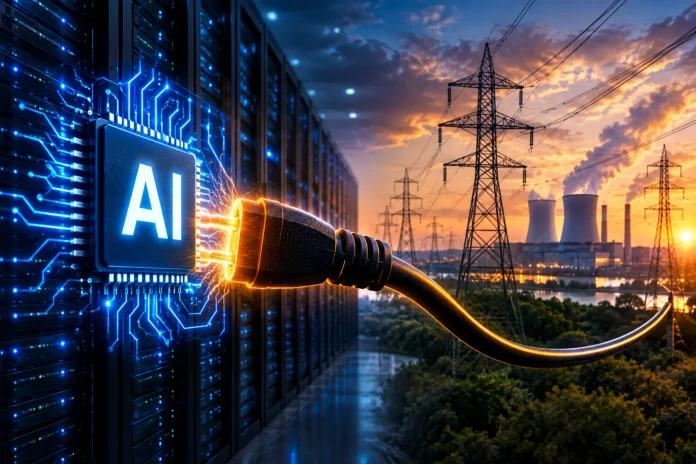
Data center power demand surges as grids lag, raising risks of shortfalls equivalent to multiple major cities.
As artificial intelligence scales rapidly, the limiting factor is shifting from advanced semiconductors and model sophistication to something far more basic: electricity. A combination of fresh data from the International Energy Agency and revised forecasts from Morgan Stanley underscores a growing mismatch between soaring data-center power needs and the ability of grids, transformers, and generation capacity to keep pace.
In 2025, global electricity demand from data centers jumped 17 percent, with AI-focused facilities growing even faster, according to the IEA’s April 2026 report Key Questions on Energy and AI. That increase far outstripped overall global electricity demand growth of about 3 percent. Data centers consumed roughly 485 terawatt-hours that year—around 1.5 percent of worldwide electricity use.
Looking ahead, the IEA projects overall data-center electricity consumption will roughly double to approximately 945–950 TWh by 2030, still representing only about 3 percent of global demand. Power use from AI-centric facilities is expected to triple over the same period. While efficiency gains per AI task are advancing at an unprecedented rate, rising user numbers and more intensive applications—such as autonomous AI agents—are driving net demand higher.
The constraints are particularly acute in the United States. Morgan Stanley analysts, in a September 21, 2026, update covered by the Financial Times, project a 15-gigawatt power shortfall relative to expected AI chip deployments by 2027. The gap is forecast to widen to 30–40 percent by 2028, or roughly 33 gigawatts residual after accounting for some mitigation measures. Analysts framed the deficit in concrete terms: New York City requires about 5.5–6 GW of baseload power, meaning the shortfall equates to roughly “six New York Cities” worth of electricity.
A supporting chart from the analysis illustrates the trajectory of data-center IT power demand (year-end installed base). It rises from under 1 GW in the early 2020s to 9.19 GW in 2025, then accelerates sharply to 17.96 GW in 2026, 35.46 GW in 2027, 52.31 GW in 2028, and 78.57 GW by 2029. Higher power draws from next-generation server architectures, including Nvidia’s Vera Rubin and Rubin Ultra systems, contribute to the steeper curve.
Roughly 43 gigawatts of AI data-center capacity is planned across the United States, according to industry trackers. Yet much of that pipeline remains stalled not by GPU shortages but by power availability. Interconnection queues in key hubs—Northern Virginia, Phoenix, and Dallas—routinely stretch four to seven years. Supply-chain bottlenecks for large transformers, turbines, and related grid equipment compound the delays.
“The problem is everything connecting those servers to power,” noted a widely shared summary of the findings posted on X by Mario Nawfal on September 22. “Grid connections, transformers and turbines are already struggling to keep pace… Much of that capacity is waiting on power, not GPUs.”
Developers and hyperscalers are adapting. Behind-the-meter solutions—onsite natural gas generation, fuel cells, batteries, and eventual small modular reactors—are gaining traction as faster alternatives to traditional grid connections. The IEA has tracked a growing pipeline of offtake agreements for SMRs, which expanded significantly in recent years. Tech companies also account for a large share of corporate renewable power-purchase agreements.
Still, near-term physical limits remain. Even as efficiency improves, the absolute scale of demand growth means electricity infrastructure has emerged as a primary bottleneck for AI expansion through the late 2020s. Policymakers, utilities, and technology firms face mounting pressure to accelerate permitting, investment in transmission and generation, and innovative onsite power solutions if the projected shortfalls are to be narrowed.
The data make clear that the smartest models still depend on reliable wall sockets—and right now, those sockets are in short supply.