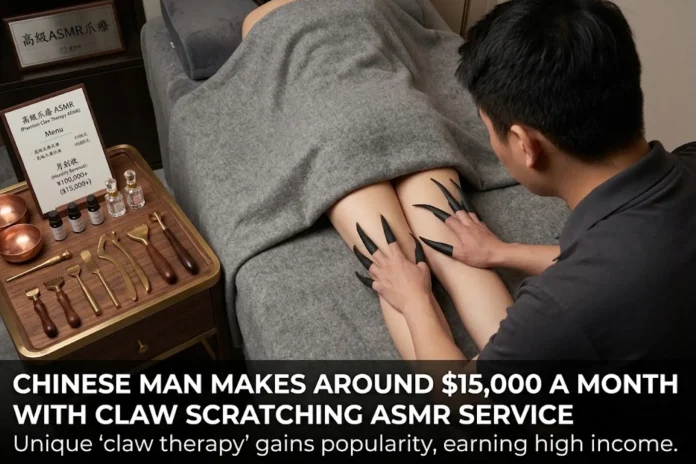
A 32-year-old entrepreneur in Shenzhen has turned professional itch-scratching into a paying business, with his two salons combining for roughly 100,000 yuan, or about $14,000, in monthly gross revenue, according to the South China Morning Post and other outlets that have covered the venture since late August.
The business belongs to Zhang Xiaoqiao, originally from Hubei province, who opened his first store under the brand Suma in Shenzhen’s Baoan District in early May, then added a second location in Futian District about a month later, SCMP reported. Per-store figures released to Chinese media are higher: the Futian store alone pulled in about 160,000 yuan, or roughly $22,500, in August, while the second location took in about 100,000 yuan, according to the South China Morning Post’s Hong Kong partner outlet, The Star / Headline Daily and Sina News — a combined monthly run rate closer to US$36,000, depending on which store-month combination you count.
Customers lie face-down on beds in a setting that resembles a massage parlor. Staff use custom-made pointed artificial nails, sometimes 3D-printed in different colors and shapes, to scratch backs, legs, necks, arms and other parts of the body. A one-hour session costs 300 yuan, or about $42 at current exchange rates, with the most popular package being an 80-minute “sleep aid” full-body session priced at 289 to 299 yuan, according to SCMP and The Star. Many customers reportedly fall asleep during sessions.
“In first-tier cities, people generally experience high levels of stress. As a result, this service is in great demand,” Zhang told media outlets. Men make up roughly 60 to 70 percent of the clientele, per Chinese-language health outlet familydoctor.cn, with women also booking sessions. Zhang says returning customers form the backbone of the business.
He built the technique himself. Zhang divided the body into five major itch zones and more than 30 smaller ones, varying pressure by area, after finding no existing model in China. He spent roughly four months developing the method and tested it on friends and online followers before opening. The concept took shape after he saw a short social-media clip of a wife scratching her husband’s back — comments under the video said people would pay for the same relief — and Zhang was reminded of childhood nights when his own father scratched his back until he fell asleep, according to Sina News. Before the scratching venture, he changed jobs seven times in his first year out of school and ran two earlier businesses that ultimately closed, he told Chinese media.
Both stores have already broken even, with one outlet recouping its investment in roughly 1.5 to 2 months, per familydoctor.cn and The Star. Now Zhang is dealing with a different kind of scrutiny. In an Aug. 29 interview on Shenzhen TV’s “第一现场” (First Scene) program, he directly addressed the “擦边” — literally “borderline” — accusations that have followed the business since it went viral, telling the program his team has “always insisted on doing legitimate, regulated things” and that they “categorically say absolutely not” when prospective customers ask online if the service is anything beyond relaxation, according to Sina News and The Cover. The pushback, which no English-language outlet has covered in detail, signals how Chinese regulators and audiences are testing the boundary between wellness services and suggestive experiences in the country’s sleep economy.
That sleep economy is large and growing. China’s wellness tourism market is projected to reach roughly $231.6 billion by 2035, expanding at an 11.1% compound annual growth rate between 2026 and 2035, according to Grand View Horizon. The country’s massage-equipment segment alone is forecast to nearly double, from $3.8 billion in 2026 to $7.53 billion by 2035 at a 7.9% CAGR, per MarkWide Research. Zhang’s itch-scratching shops sit inside both categories. The same sleep-as-currency idea surfaced earlier in 2026 with a Baotou mattress company’s “lie-flat” competition that paid participants to sleep as long as 24 hours, per Hypefresh’s coverage of that China sleep-competition event.
Zhang is not the first business owner to turn a small, awkward human need into a paying service — Hypefresh has tracked similar pivots, including a New York woman paid to sit in idling cars as a side hustle, and the $22 billion Raising Cane’s empire built from a college paper Todd Graves was told would fail. Each of those stories started as a punchline; some, like Zhang’s, are starting to look like a category.
Now comes the expansion phase. Zhang has said a third Shenzhen store is already in the works and that he is fielding inquiries — Sina reported “hundreds daily” — about training and franchise-style partnerships, mostly from existing offline operators. He has framed his long-term goal as a network of 100 outlets. Representatives for Zhang did not respond to a request for comment on international expansion plans.