

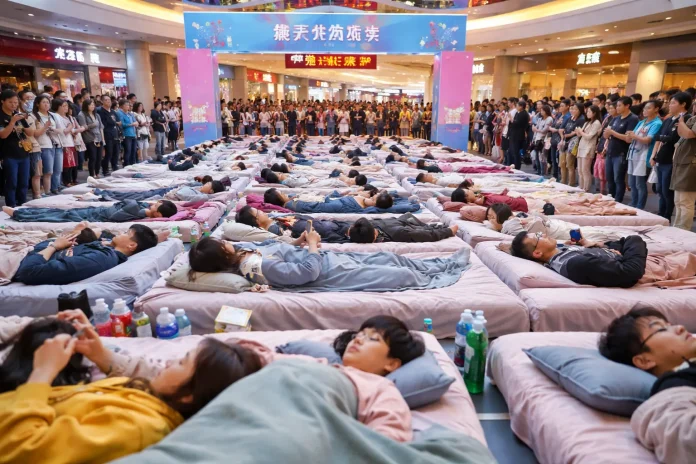
A mattress company in China is drawing attention online with an unusual competition that rewards contestants for doing the exact opposite of hustle culture: lying down.
The event, held in Baotou in northern China’s Inner Mongolia region, invited more than 240 participants to compete in a “lie-flat” endurance challenge — with a top prize of roughly $430. The rules were simple but strict: contestants had to remain on a mattress without standing, sitting up or leaving, even to use the bathroom.
Participants were allowed to scroll their phones, read, eat or sleep, but once they broke the “lying flat” position, they were out. By the 24-hour mark, the majority had dropped out. The eventual winner, a 23-year-old man, lasted 33 hours and 35 minutes.
The contest quickly went viral, not just for its unusual premise — and reports that some contestants wore diapers to comply with the rules — but for what it represents culturally.
The competition taps into the Tang Ping movement, or “lying flat,” a term that has gained traction among young people in China in recent years. The phrase describes a growing mindset of opting out of intense workplace pressure and scaling back ambitions in favor of a more minimal, low-stress lifestyle.
Often viewed as a quiet pushback against the country’s demanding work culture, tang ping has been compared to “quiet quitting” trends seen elsewhere. Rather than direct protest, it reflects a more passive resistance — choosing rest over relentless productivity.
Events like this one highlight the tension between that philosophy and commercial interests. By turning “lying flat” into a branded competition, companies are both acknowledging and capitalizing on a sentiment rooted in frustration with modern work expectations.
The Baotou contest also follows a similar endurance-style event held in November 2025, where participants competed under nearly identical conditions, further fueling online discussion about youth burnout and the meaning of success.
Some observers have also linked the trend to broader disengagement behaviors among young people — sometimes referred to as “bail down” attitudes — where individuals step back from high-pressure systems rather than actively challenge them.
For now, the “lie-flat” contest is being framed as both a marketing win and a cultural moment. But its popularity points to something deeper: in an era defined by constant output, even rest can become a form of rebellion — and, increasingly, a spectacle.

 to promote healthy sleep. Learn more!)