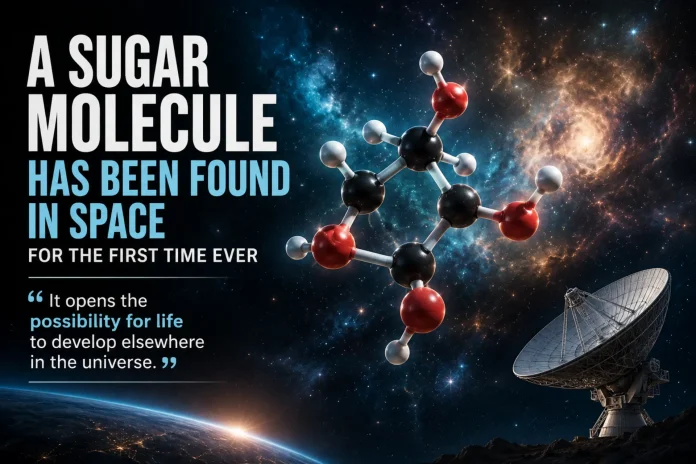
Astronomers have detected a sugar molecule in interstellar space for the first time ever. Researchers say the finding opens the possibility for life to develop elsewhere in the universe. The molecule, known as erythrulose, is a four-carbon ketose sugar that serves as a key building block in prebiotic chemistry.
The discovery took place in the molecular cloud labeled G+0.693−0.027, located near the center of the Milky Way galaxy approximately 26,745 light years from Earth. This dense region of gas and dust provided the ideal environment for the detection through radio telescope observations. The research paper detailing the results was published on July 13, 2026, in the journal Nature Astronomy, building on spectral surveys conducted in previous years.
Erythrulose was identified using ultrasensitive broadband spectral surveys with the Yebes 40-meter radio telescope in Spain and the IRAM 30-meter telescope. Scientists matched 17 individual transitions grouped into 12 sets to the laboratory spectrum of the molecule, confirming its presence with high confidence. The excitation temperature registered at about 11.3 Kelvin, matching the cold conditions of the cloud, while the column density reached 8.7 times 10 to the 13 per square centimeter and the abundance relative to molecular hydrogen stood at 6.4 times 10 to the negative 10.
This sugar forms efficiently on the surfaces of interstellar dust grains coated with amorphous solid water ice. Quantum chemical calculations and kinetic Monte Carlo models show it arises from simpler two-carbon precursors such as glycolaldehyde and ethylene glycol through hydrogen abstraction, activated complex formation, intersystem crossing, and radical recombination. The process produces both enantiomers equally and operates effectively in the shielded, low-temperature environment where ultraviolet radiation cannot easily destroy the growing molecules.
Erythrulose stands out because it appears at least eight to seventeen times more abundant than three-carbon sugars such as glyceraldehyde and dihydroxyacetone, which remained undetected in the same sensitive observations. As a ketose, it can isomerize into aldoses like threose or erythrose in aqueous conditions, potentially contributing to pathways for nucleic acid analogs and early metabolic processes. Estimates suggest that substantial quantities of such sugars could have reached early Earth during the Late Heavy Bombardment period, supplementing the chemical environment for the emergence of life.
The detection addresses a central question in origin-of-life research regarding how monosaccharides could accumulate in sufficient concentrations. Laboratory experiments on Earth often fall short in producing them under prebiotic conditions, yet the interstellar medium now shows a natural pathway. This expands the understanding of chemical complexity in space, demonstrating that molecules with 14 atoms and four oxygen atoms can assemble before stars and planets fully form. The result positions erythrulose as the first confirmed sugar and the largest non-cyclic molecule of its kind identified in the interstellar medium.
Lead researcher Izaskun Jiménez-Serra and her international team from institutions across Spain, the Netherlands, Germany, Japan, Chile, and the United States emphasize that such findings highlight the interstellar medium as a viable source of prebiotic feedstock. The work involved collaboration among astrochemists, spectroscopists, and modelers who combined observational data with laboratory measurements and theoretical simulations. It builds on prior detections of related organics while breaking new ground in sugar chemistry beyond our solar system.
Overall, the discovery enriches models of cosmic chemical evolution and encourages continued exploration of molecular clouds with advanced telescopes. It illustrates how simple starting materials in cold, dense regions can lead to complexity over cosmic timescales, potentially seeding habitable worlds throughout the galaxy. This step forward connects the chemistry of distant space directly to the origins of life as we understand it.