

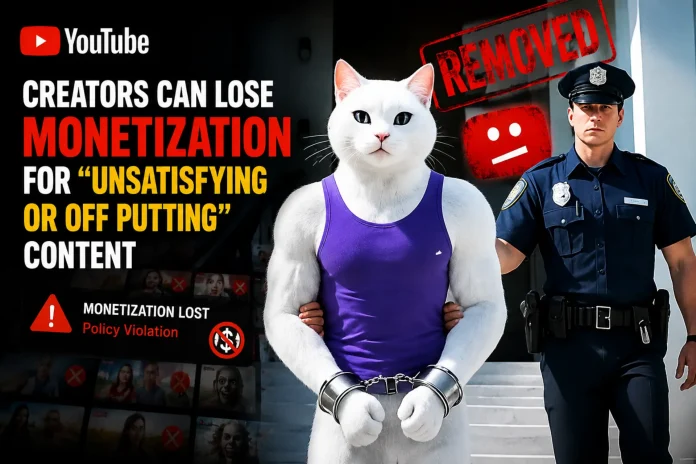
YouTube now explicitly states that creators can lose monetization for videos it considers unsatisfying or off putting, including repetitive shock videos that prioritize views over substance. The platform has updated its Partner Program policies to detail three specific categories of ineligible content. This clarification, reported widely in mid-July 2026, aims to give creators clearer guidance on what qualifies for ad revenue.
The new rule covers generic or repetitive content, unsatisfying or off-putting material, and videos with AI generated personas presented as human experts on sensitive subjects such as health, legal matters, or finances. Unsatisfying or off-putting content includes videos relying on emotionally manipulative formulas, mimicking existing formats until they feel interchangeable, or using shock and surprise solely to attract clicks.
Examples include repeated depictions of violence or loss without a cohesive story, exaggerated animal distress scenarios, stitched together unrelated AI clips for shock value, and fake realistic footage of celebrity deaths or disasters. YouTube penalizes these because they disappoint viewers seeking original, satisfying experiences and fail to deliver creative, educational, or other substantial value. The rules build on earlier policies against inauthentic material, with a related rename and clarification dated July 15, 2025, and the broader update detailed publicly around July 13, 2026 via the official help center.
Reviewers evaluate channels based on overall themes and most viewed videos to enforce the standards across long form content, Shorts, and livestreams. Creators can still earn from work offering original perspectives, cohesive storytelling, or personal spins on trends, and AI tools remain acceptable when they support genuine creative input. The policy update happened through direct revisions to the YouTube Partner Program policies page on the support site. This approach helps protect the platform’s advertising ecosystem while encouraging higher quality production. One affected creator, the owner of the HPad channel also known as H Pad2 on Reddit, reported that his monetization violation changed from inauthentic content to unsatisfying or off putting. The 18 year old channel with more than 225,000 subscribers features long form physical testing and destruction of household appliances like vacuums and fans recorded outdoors with professional equipment. He claimed the change cost him at least $15,000 in lost revenue over three months following an initial demonetization around April 2026.
This situation illustrates the challenges independent creators face as platforms refine enforcement amid evolving content trends. Many producers invest significant time and resources into consistent series only to encounter shifting interpretations of value. The clarification provides transparency but also prompts questions about uniform application across diverse niches. For the complete official policy text, visit the YouTube Partner Program policies page.
The development reinforces YouTube’s focus on authentic content that genuinely engages audiences rather than relying on repetitive or manipulative tactics. Creators adapting with stronger narratives and educational elements may navigate these standards more successfully. As the platform continues to prioritize viewer satisfaction and advertiser suitability, the balance between creative freedom and monetization eligibility remains a key point of discussion in the creator economy.

