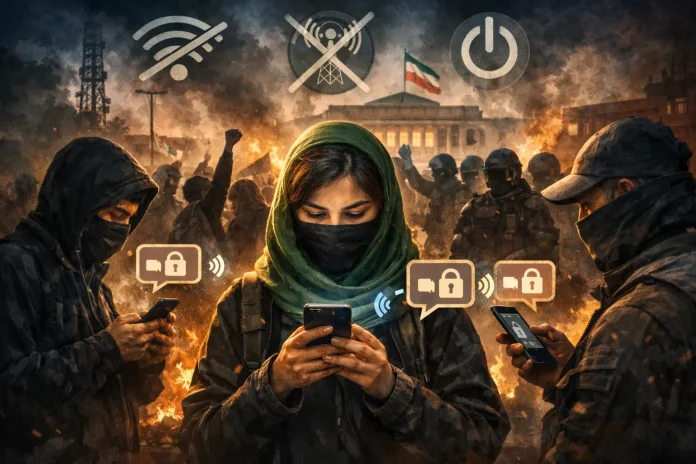
Jack Dorsey’s latest app, Bitchat, enables users to send messages, photos, and audio clips without any internet connection, central servers, or personal identifiers. It relies entirely on Bluetooth mesh networks, in which devices within 10 to 30 meters relay data to one another, forming temporary communication chains in crowded areas. The app has proven invaluable for activists in countries facing government-imposed internet shutdowns, but its practical limitations make it far less revolutionary for protesters in the United States.
Bitchat launched in July 2025 and quickly drew attention for its uncompromising privacy design: no accounts, no phone numbers, and no persistent tracking. Recent updates added media-sharing capabilities and optional Tor routing when limited internet is available, further shielding users from surveillance. A third-party security audit confirmed the implementation of important fixes, addressing early concerns while reinforcing the app’s focus on resilience in hostile environments.
Dorsey developed Bitchat out of a long-held belief that centralized platforms give governments and corporations too much control over communication. After stepping down as Twitter CEO in 2021 and leaving the board in 2022, he redirected his efforts toward Bitcoin, open protocols like Nostr, and Block’s TBD division, which is building Web5—a vision for a fully user-owned internet. Bitchat extends that philosophy by eliminating servers altogether, making it impossible for authorities to shut down the entire network at once.
The app’s real-world impact has been clearest during internet blackouts in repressive regimes. Protesters in Iran and Uganda downloaded it in large numbers to coordinate safely, share updates, and maintain contact when traditional networks were disabled. These shutdowns have become a common tactic worldwide, and Bitchat offers one of the few reliable ways to communicate when infrastructure is deliberately cut off.
In the United States, the situation is markedly different. Protesters rarely encounter nationwide or sustained internet restrictions, thanks to multiple competing cellular providers and robust infrastructure. Encrypted apps like Signal and Telegram already provide strong privacy and seamless large-group coordination over standard data connections, meeting most organizers’ needs without requiring physical proximity.
Bitchat’s short Bluetooth range means it only works effectively in very dense crowds. Once participants spread out or move quickly, the mesh network collapses, rendering it impractical for most American demonstrations. While it could serve as a backup during natural disasters or hypothetical future speech restrictions, it has not gained meaningful traction among U.S. activists who continue to rely on established tools.
Even with its limited domestic role, Bitchat reinforces Dorsey’s broader message that centralized systems remain fragile by design. The app stands as a proof of concept for truly independent communication and keeps the conversation alive about network resilience at a time when digital rights face ongoing scrutiny worldwide. For now, its greatest value lies overseas, where the need for offline, surveillance-resistant messaging is most urgent.