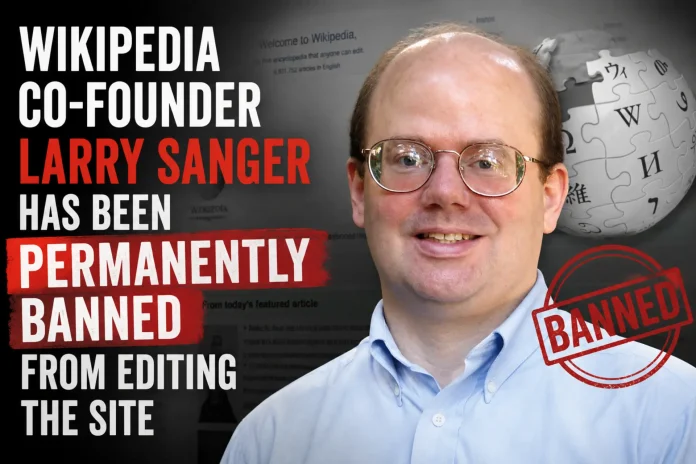
Larry Sanger, the co-founder who named Wikipedia and helped draft its foundational policies on neutrality and sourcing in 2001, has been permanently banned from editing the collaborative online encyclopedia. Community editors reached this decision in June 2026 after reviewing his recent activities aimed at increasing viewpoint diversity across the platform. The action prevents him from making any further contributions despite his historic role in establishing the project that now serves billions of readers monthly.
Sanger began his encyclopedia work as editor in chief of Nupedia, a more formal predecessor project that required expert review before articles could be published. He introduced the concept of using wiki software to accelerate content creation, leading directly to Wikipedia’s rapid expansion after its January 2001 launch. He departed active involvement in March 2002 citing financial constraints and disagreements over community direction but continued shaping discussions around knowledge reliability. Later efforts included founding Citizendium to prioritize verified expertise and real name participation over anonymity, as further detailed in coverage of his permanent ban from the encyclopedia he helped create.
More recently Sanger proposed establishing a WikiProject Intellectual Diversity to address what he viewed as imbalances in how sources and perspectives are weighted on politically sensitive subjects. He shared information about the active internal debate over this proposal through posts on his social media account and connected readers directly to the relevant discussion pages. He also spoke in a public interview encouraging wider participation in editing from communities he believed could help restore greater balance. These steps formed the basis for the subsequent internal examination of his conduct in line with the platform’s guidelines on canvassing that prohibit certain forms of external recruitment.
The review occurred through the platform’s administrators noticeboard where participants evaluated whether the external promotion constituted prohibited canvassing by seeking to bring outside voices into an ongoing decision making process. Editors noted his relatively low volume of recent direct article edits compared to his focus on policy and project proposals. After several days of discussion a clear consensus emerged in favor of an indefinite site wide ban from editing privileges. This sanction was implemented and reaffirmed following a short period of temporary unblocking, as documented in reporting on the controversial decision to bar Wikipedia’s own co-founder.
Sanger addressed the ban directly in public posts describing it as an indefinite block imposed for unstated reasons by the consensus of a mob. He emphasized the absence of due process including no formal charges, no opportunity for structured defense, and adjudication by self selected participants who opposed his positions. He stated that the specific allegations leveled against him amounted to lies and misrepresentations of his goals. In additional remarks he expressed surprise at the outcome and questioned the fairness of the community driven disciplinary mechanisms. The episode has drawn renewed attention to Wikipedia founder Jimmy Wales and his own contentious relationship with co-founder status questions, highlighting long-standing tensions between the encyclopedia’s original architects.
The ban illustrates ongoing tensions in how volunteer moderated platforms manage internal criticism and reform proposals from their own founders and early contributors. Sanger has consistently argued for stronger adherence to neutrality principles since leaving daily operations, and his latest initiative was presented as a constructive effort to broaden representation rather than undermine the project. Yet the community’s response prioritizes enforcement of participation rules over accommodating such advocacy from high profile figures. This dynamic may prompt further examination of governance structures that aim to preserve openness while maintaining order among thousands of active editors. Similar debates about platform bias and content moderation have surfaced across the tech industry, including backlash over alleged bias in automated content systems, showing how questions of neutrality extend well beyond Wikipedia’s volunteer community.