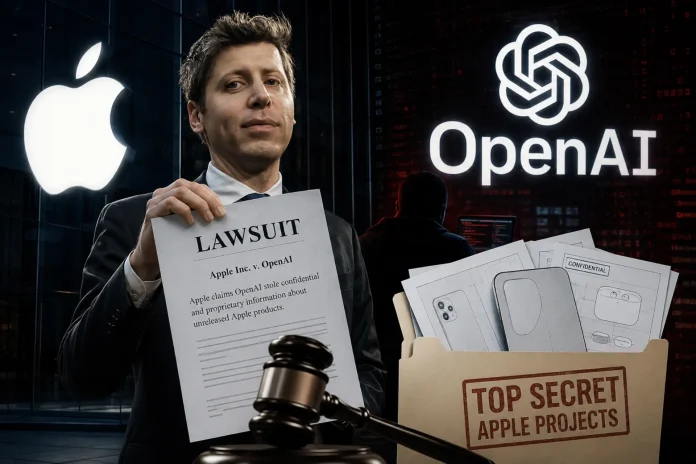
Apple, the iPhone maker has sued OpenAI, the company behind ChatGPT and led by CEO Sam Altman, alleging that it systematically stole trade secrets about unreleased hardware products and designs to accelerate its own push into consumer electronics.
The complaint, filed on July 10 in the U.S. District Court for the Northern District of California, targets OpenAI entities along with two former Apple executives now working at the AI firm. It claims the defendants misappropriated confidential information on unreleased technologies, manufacturing processes, supply chain strategies, and product designs. According to the filing, this effort was part of a coordinated campaign to help OpenAI develop competing AI-powered hardware devices rather than relying on independent innovation.
Apple specifically accuses the company of using former employees to extract sensitive details during recruitment and after their departures. One defendant, former Apple engineer Chang Liu, allegedly retained access to internal systems and downloaded dozens of confidential files containing engineering specifications and project data. Another, Tang Yew Tan, who previously led product design for the iPhone and Apple Watch, is accused of leveraging his knowledge of Apple’s internal codenames and supplier relationships while coaching job candidates to bring physical components and design materials to interviews at OpenAI.
These actions tie directly into OpenAI’s broader hardware ambitions, pursued under Sam Altman’s leadership and his prior ChatGPT shutdown backpack scheme. The company has pursued new consumer devices through its acquisition of io Products, a startup co-founded by former Apple design chief Jony Ive and Tan. The lawsuit portrays OpenAI’s strategy as relying on unlawful shortcuts to replicate Apple’s hard-won expertise in hardware rather than building it organically.
OpenAI has responded by stating it has no interest in other companies’ trade secrets and remains focused on building innovative technology that empowers people. A spokesperson indicated the company is reviewing the complaint but offered no detailed rebuttal of the specific allegations at this stage.
The case represents a major rupture in the relationship between the two companies, which previously collaborated on integrating ChatGPT into Apple’s software features. By targeting OpenAI’s hardware efforts, Apple is effectively challenging the company’s expansion plans in a space where physical devices could one day compete directly with iPhones and other Apple products.
What happens next will likely involve standard legal proceedings in trade secret cases. OpenAI is expected to file a formal response, potentially including a motion to dismiss or counterclaims. If the case advances, discovery could give Apple access to internal OpenAI documents detailing its hardware development, which might reveal how much of the technology relies on the allegedly stolen information.
Apple may also seek a preliminary injunction to prevent OpenAI from using the disputed materials in its upcoming devices. Such a ruling, if granted, could delay OpenAI’s planned hardware launch, which the company has targeted for sometime in the coming years. Settlement talks often occur in these high-profile disputes to avoid prolonged public scrutiny and the risks of a full trial.
Beyond the courtroom, the lawsuit signals heightened competition in the AI hardware sector and may prompt other technology companies to tighten controls on employee transitions and confidential information. It could also influence investor perceptions of OpenAI as it prepares for potential future funding rounds or public market considerations, while reinforcing Apple’s determination to protect its core IP in design and manufacturing, the discipline Steve Jobs rebuilt from the brink in 1997.