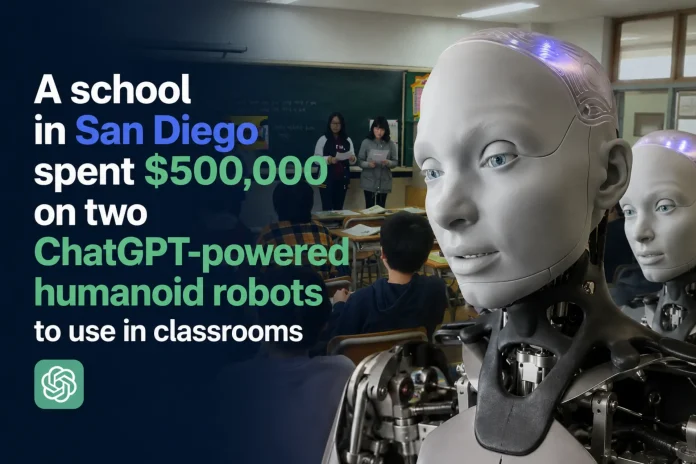
A charter school network in San Diego spent $500,000 on two humanoid robots powered by ChatGPT to assist with classroom support through four distinct roles, including that of a teacher, a wellness coach, a college planner, and a translator. The purchase targets needs in alternative education settings where students often require extra individualized attention to recover academic credits and stay on track for graduation. These robots provide a new way to expand available help without immediately adding more human staff members to every session. The network sees this as an opportunity to test advanced technology in real learning environments, according to a Voice of San Diego-sourced pilot report.
Altus Schools operates resource centers across Southern California focused on flexible and personalized learning for a student population that includes many learners who face barriers in standard classrooms. The same challenges that have made screen-first habits a growing concern for educators, from variable attendance to the need for targeted remediation, make consistent personalized guidance difficult to scale with existing resources alone. By introducing physical robots, the school aims to supplement educator efforts and offer students exposure to innovative tools that could improve engagement during support sessions. Officials believe this approach can help address capacity issues in their hybrid model of education.
The robots take on specific personas to match different student needs during interactions at the resource centers and operate using technology from OpenAI. One role involves delivering instructional content similar to a teacher while another focuses on supporting student wellbeing as a coach. Additional functions include guiding plans for college and future careers as well as providing translation services when language barriers arise. These capabilities allow the systems to adapt to conversations and switch focus based on what a student requires at the moment, though all activity happens under direct staff supervision.
School dean Cathryn Rambo led communications about the project to families and worked closely with the manufacturer to set up the systems appropriately. The robots come from Engineered Arts, a company based in the United Kingdom that specializes in expressive humanoid designs. Collaboration with their engineers helped customize instructions and allow certain impersonations of figures while maintaining safety boundaries around data and interactions. This partnership enabled the school to tailor the technology specifically for educational use rather than ready-made deployment.
Currently the two robots are deployed and active in the San Diego area resource centers where staff continue to explore their full range of functions. The pilot remains open-ended with no fixed end date as teams gather feedback from initial student sessions. Students have begun interacting with the machines in small groups or individually, often describing them as unusual at first, though some adjust after direct experience. The school continues to promote the effort on its own channels, as described on the Altus Schools website, as a step toward redefining how personalized support can incorporate new forms of technology.
Early observations from a test lesson showed the robot sometimes speaking too quickly or needing repeats when role-playing as a historical figure, which highlighted areas for refinement. Education researchers have noted the lack of broad evidence that such physical artificial intelligence tools deliver reliable improvements in learning outcomes or safety at scale, concerns echoed in broader warnings about AI systems acting outside their guardrails. Questions also persist about resource priorities given the investment size and whether similar funds could support expanded human-led services instead. The network maintains that the focus stays on research and learning rather than complete replacement of traditional methods.
This initiative shows how some schools are turning to artificial intelligence solutions to tackle practical challenges in serving students who need flexible support systems. Success will ultimately depend on measurable gains in areas like student motivation and academic progress, which the pilot has yet to demonstrate through hard data. The human aspects of teaching, such as building trust and adapting in real time, remain hard to replicate fully with machines at this stage. Ongoing evaluation and open sharing of results will help determine if these robots represent a valuable addition or mainly an experimental addition to the educational toolkit.