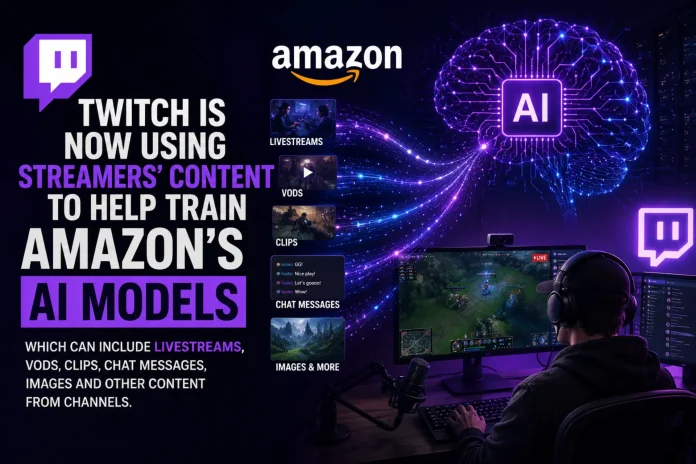
Twitch has begun feeding streamers’ livestreams, VODs, clips, chat messages, images and channel text into Amazon’s generative AI models by default, requiring creators to dig into buried privacy settings to opt out.
The Amazon-owned platform added a toggle labeled “Training for Generative AI” under Security and Privacy on August 12, 2026. It is switched on for every account unless the user turns it off. Once disabled, a channel’s streams, on-demand recordings, clips, stream chats, pictures and text will no longer be used for future training of Amazon models designed to generate or synthesize text, audio, images or video.
Streaming reporter Zach Bussey first spotted the new toggle inside Twitch’s account settings on August 12 and posted a screenshot and explanation of the setting. The direct link to the settings page spread across social platforms the same day, largely because Twitch had not issued a prominent announcement of its own. Bussey’s post noted that the feature was already enabled by default and pointed users straight to the opt-out location.
Twitch’s own support language makes clear that the preference covers only generative models. Other AI-supported features, including AutoMod for chat safety, content recommendations, real-time sponsorship tools and automatic captions, continue to operate regardless of the setting. The company states that those systems do not retain data to train models that produce new content.
A significant catch remains for viewers. If a user chats in someone else’s stream and that channel has not opted out, the messages can still be included in the training data under the host’s preference. Twitch confirmed the host-controlled rule in its updated documentation and community notes attached to the official announcement.
The setting does not appear in the creator dashboard. Users must open account settings, select Security and Privacy, scroll to the bottom of the page and flip the toggle. The change applies only to future training; Twitch has not said whether material already ingested can be removed.
Chief Product Officer Mike Minton addressed the backlash during a live Patch Notes stream alongside Head of Community Mary Kish. When pressed on why the feature is opt-out rather than opt-in, Minton answered directly:
“If it was opt-in, nobody would opt in. That’s honestly the answer.”
He added that nearly every major content service defaults to the same approach and that Twitch’s decision to offer an opt-out is the distinction.
Minton, who previously served as Twitch’s chief monetization officer, had already acknowledged in 2024 that Amazon uses Twitch content for AI training. At an event hosted by The Information he said, “Yeah, for sure,” while noting the practice stayed within privacy regulations and user-trust boundaries. The BBC’s report on the controversy also notes that Twitch is now allowing users to stop Amazon from training its generative AI models. On the recent stream he said he could not confirm the full scope of past training because he does not know every model Amazon has built.
Twitch’s FAQ gives one concrete example of how the data is applied. Streamer audio can refine speech-to-text models that improve captions on Twitch itself and across other Amazon services. The broader purpose, according to the company, is future improvements to generative models that create text, audio, images or video. The data will not be resold to outside companies, Minton said.
Reaction across the platform was immediate and largely negative. Streamers flooded the official support post and the live Q&A chat with demands that the setting be flipped to opt-in by default. Some creators posted guides showing others how to locate the toggle after Bussey’s screenshot made the option widely visible. Community notes on Twitch Support’s announcement highlighted the chat-message loophole. TechCrunch documented the concentrated backlash from creators who were opted in by default.
The timing of the visible setting follows years of quiet use. Amazon acquired Twitch in 2014. Live streams supply continuous multimodal data—synchronized video, natural speech with varied accents, gameplay visuals and rapid chat text—that is difficult to obtain at the same scale from other sources. That material can support models used in captions, conversational agents and other Amazon products, though the company has not detailed every downstream application.
Users who wish to exclude their channel content from future generative training can do so at twitch.tv/settings/security. The preference is account-wide and carries over to the mobile app. Opting out does not affect discoverability or the operation of safety and recommendation systems, according to Minton.
Twitch framed the addition as a response to community feedback. Kish told the live audience the company does not expect creators to be happy about the policy. The setting remains on by default for anyone who has not yet found it.