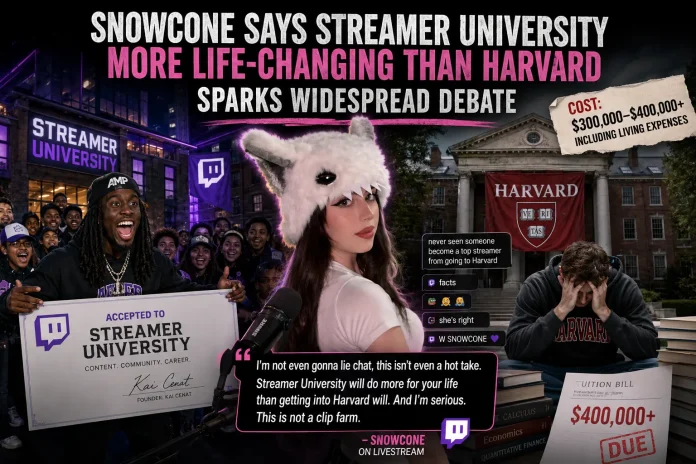
Twitch personality Snowcone sparked widespread debate after declaring that acceptance into Kai Cenat’s Streamer University could be more life-changing for aspiring content creators than getting into Harvard.
“I’m not even gonna lie chat, this isn’t even a hot take. Streamer University will do more for your life than getting into Harvard will. And I’m serious. This is not a clip farm,” Snowcone said during a recent livestream. She went on to note that she’s “never seen someone become a top streamer from going to Harvard,” while highlighting the Ivy League school’s high cost, which can exceed $300,000–$400,000 including living expenses.
The comments quickly gained traction online, resonating with a generation of young creators navigating the creator economy.
Snowcone’s perspective carries particular credibility given her own trajectory. Prior to attending the inaugural Streamer University event roughly a year ago, the streamer — known for her high-energy mix of gaming (including Overwatch), IRL, and reaction content — was averaging around 45 viewers, working a full-time day job, living paycheck to paycheck, and had recently been let go. Her social followings were minimal across platforms.
Following the event, her audience exploded. She now commands more than 85,000 followers on Twitch, over 200,000 on TikTok, and 100,000 on Instagram, attributing much of the breakthrough to the networking, visibility, and momentum generated by the program.
Unlike a traditional university, Kai Cenat’s Streamer University is a high-production, multi-day immersive bootcamp designed for aspiring streamers and creators. The inaugural 2025 edition, held at the University of Akron, brought together around 120 selected participants for roughly four days of panels, collaborative streams, challenges, and direct exposure through massive co-streaming.
The program features sessions with established influencers on topics ranging from audience building and platform algorithms to content strategy and networking. Applications are notoriously competitive, drawing hundreds of thousands to over a million submissions, with selections based on video auditions showcasing personality and potential rather than existing follower counts. In creator circles, it’s frequently meme’d as harder to get into than Harvard.
Participants in the first edition saw dramatic growth. India Love reportedly jumped from roughly 4,000 Twitch followers to nearly 500,000, while others experienced boosts from the low thousands into the tens or hundreds of thousands. The 2026 edition is already generating significant hype with new applications open and cinematic promotional trailers.
Snowcone participated in the first iteration and has been vocal about its impact, positioning the event as a direct launchpad in an industry where success often hinges on charisma, consistency, virality, and strategic connections rather than formal credentials.
Many of the biggest names in streaming, including Cenat himself, xQc, Ninja, and Pokimane, built their careers without traditional elite college paths, often as self-taught talents or dropouts.
While Snowcone’s take has energized the streaming community, it underscores a classic apples-to-oranges comparison between two very different paths. Harvard and other top universities continue to provide strong median outcomes, broad skill development, and access to stable careers in tech, finance, law, and beyond. Streaming and content creation, by contrast, operate as a high-variance, winner-take-most field where a small fraction achieve major success while many others face burnout, platform shifts, and inconsistent income.
Still, for a specific cohort of young people grinding daily streams with dreams of full-time creator careers, Snowcone argues that the immediate ROI and targeted exposure from an event like Streamer University can outweigh a traditional degree.
The discussion reflects larger shifts in 2026’s attention economy, where alternative routes through digital platforms and creator-focused events are increasingly viewed as legitimate — if risky — ladders to success alongside conventional education.