

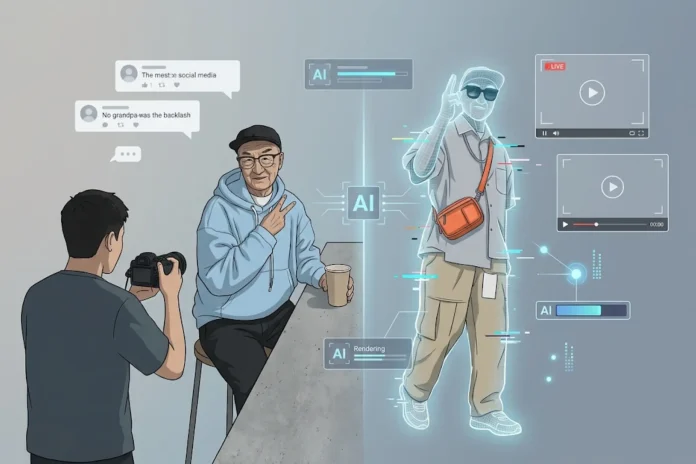
The AI videos are gone. Kang Kang, the Chinese influencer behind the “Kang Kang and Grandpa” fashion account, has pulled every artificially generated clip of his late grandfather from the platform where the pair built an audience of nearly six million followers, The Paper reported on November 11, after weeks of criticism over recreating a man who could no longer consent to the performances.
The grandfather, a retired university teacher known to fans as Trendy Grandpa, died in his sleep in early September at an age Chinese outlets have reported from 88 to 90. The family announced his death on September 9 and kept his funeral simple, as he had asked. A farewell video used his voice for a last message: “Our story together has come to an end, but your own stories must carry on.”
His account counted 5.787 million followers and more than 130 million likes, according to the state wire ECNS, and had taken off in 2020 when the then 83-year-old began modeling hats, sunglasses and coordinated streetwear beside his grandson. Then October brought the videos back. One placed the grandfather beside Kang Kang as an infant. Another showed him queuing for designer sneakers and asking older shoppers whether they followed G-Dragon.
A third clip ran a repeated exchange backward through history. Asked whether he had been Kang Kang in a previous life, the recreation answered “Previous lives do not exist,” and kept answering the same way 400 years back, 3,000 years back, 10,000 years back as a caveman, and 50 million years back as a prehistoric fish, according to the South China Morning Post. The clips carried the platform’s AI labels. That disclosure settled nothing.
Kang Kang answered the backlash on November 8 with a statement that read as much like an apology as an explanation. The videos, he wrote, were meant to show “interesting behind-the-scenes stories that happened between us and grandpa, which regrettably weren’t turned into videos,” and to let viewers see “a more interesting grandpa” and keep a form of companionship going. “If this has caused you disturbance, we will think more seriously about whether to continue,” the statement added, as Dexerto reported at the time. Three days later the AI posts and the statement itself were deleted, and the Xiaohongshu page was wiped as well, its nickname and avatar reset to platform defaults.
The deletion closed a chapter the grandfather himself had narrated in public. In May 2025 he told followers doctors had found a brain tumor, saying “something grew in my head,” and kept filming through treatment in a series he called his radiation therapy diary. His advice to other patients was plain: eat what you love when eating gets hard, rest when the energy runs out, and “let’s get through this tough time together.” He said he would dress well and look at the scenery for as long as he could still move, because he wanted no regrets and did not want to “suddenly disappear from everyone’s world.”
Chinese legal scholars read the episode as a rights question, not a sentiment question. Zhang Linghan of the Institute of Data Law at China University of Political Science and Law has said that recreating a deceased person with AI without the consent of close relatives infringes personality rights under the Civil Code, even with no money involved. Shi Jiayou, a law professor at Renmin University of China, made the same point about this case. Article 994 of the Civil Code lets spouses, children and parents demand liability when a dead person’s name, likeness or reputation is harmed, and a platform’s AI label does not substitute for that consent.
The fight over who may animate the dead is already global. Bernice King had to publicly confront an AI-generated image that placed her father, Martin Luther King Jr., in a viral photo. Estate and family consent has become the dividing line in every one of these cases, and it is the same line Kang Kang crossed when the account he ran turned his grandfather into new content.
Not every digital double draws fire. A dancer with ALS performed on stage through a digital avatar she controls, a use framed around her own agency rather than her absence. In China itself, another creator spent one million yuan becoming a humanoid robot while alive to make the choice himself. The discomfort concentrates on the dead, who cannot be asked.
Grief technology is also becoming a business. Asia Daily’s reporting on the case notes that other Chinese creators now build AI likenesses for bereaved families as a private service, smaller in audience but built on the same methods. People’s Daily has warned since 2024 that AI resurrections of public figures without family permission are infringements waiting for a courtroom.
What remains on the Douyin account is where September left it: the original obituary and its borrowed voice. Kang Kang has not said whether the AI project is finished or only paused, and no close relative beyond him has spoken publicly about consent. The followers who made a quiet old man famous are still split over what his account owed him.

