

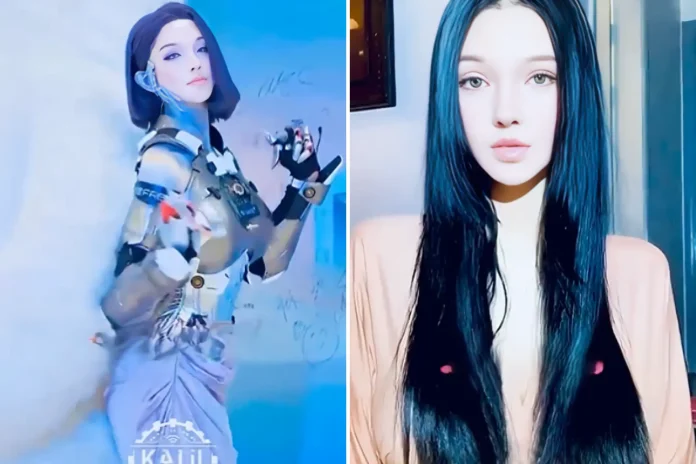
In viral clips flooding X, TikTok, and YouTube Shorts, a towering figure glides through crowds with unnaturally stiff steps, unblinking eyes, and a gleaming metallic bodysuit that catches the light like polished chrome. Viewers comment in droves:
“Is that a real robot?” “AI generated?” “No way that’s human.”
The central tension hits immediately in an era of deepfakes and advanced robotics, where does performance end and reality begin?
Right there in the middle stands Qián Bīng online, folks know her as Daloatian, sometimes spelled Dalaotian. April 2018 marked her start on Douyin, which happens to be China’s answer to TikTok. Beauty shots and makeup clips put her on the map at first. Instead of subtle changes, she went bold full face flips that grabbed attention fast. By mid-2019, one clip about fixing makeup blew up, landing north of 600,000 thumbs-up. Working with big names like Estée Lauder helped widen her reach. Even in a crowded space full of creators trying hard, she held steady ground across years.
By March 2023, Qián Bǐng had shared news of her divorce following ten years together, married since 2019. Though quiet at first, she eventually opened up talking through tough emotions and wanting control over money matters. As health problems surfaced, posts became rare. Then, out of nowhere by mid-2024, a different version stepped back into view.
Her transformation into a humanoid robot-inspired character became the defining shift. Qián Bīng, who stands approximately 188–190 cm (around 6’2″+), adopted silver metallic bodysuits with mechanical accents and exposed “wiring,” oversized light blue contact lenses, short bob wigs in blonde or black, heavy prosthetic-style makeup for a smooth, doll-like face, and rigidly mechanical movements with minimal blinking or facial expression.
Reports from Chinese media, picked up by the South China Morning Post, mention she said changes to her face and chest cost more than 1 million yuan roughly $140,000 in U.S. dollars. That amount, floating around online, pulls together expenses like surgeries, injectables, outfits, even artificial body parts. Though many repeat it, there is no verified audit of these numbers in any published source.
Out of nowhere, videos flooded social media in Europe and America when people noticed how tall she is, her blank stare, her look straight out of a sci-fi novel all combining into something oddly unsettling. You see her standing stiff at gadget expos, one moment captured during 2024 at Beijing’s robot gathering, lined up next to moving machines built by firms such as EX Robots. Folks watching live or scrolling later were convinced, at first glance, that she wasn’t human but some kind of high-end machine pretending to be real.
Public reactions split sharply. Supporters call it
“high-level performance art and digital self-branding.”
Critics question the psychological toll of such extreme identity shifts in influencer culture, asking what it says about beauty standards and the pressure to reinvent radically for relevance.
This phenomenon sits within China’s booming humanoid robotics sector. The country hosts over 140 humanoid robot companies and launched more than 330 products in 2025, accounting for over 80% of global installations. Government support positions robotics as a strategic industry, influencing fashion, art, and online identities.
For U.S. and global audiences, Qián Bīng’s story reflects deeper truths about the digital age. Internet culture increasingly rewards extreme visual reinvention and content that toys with viewers’ ability to separate human performance from machine-like illusion. As AI and robotics reshape entertainment and identity, cases like hers highlight how influencers turn personal reinvention into spectacle blurring lines between authenticity, art, and algorithm-friendly futurism.

