

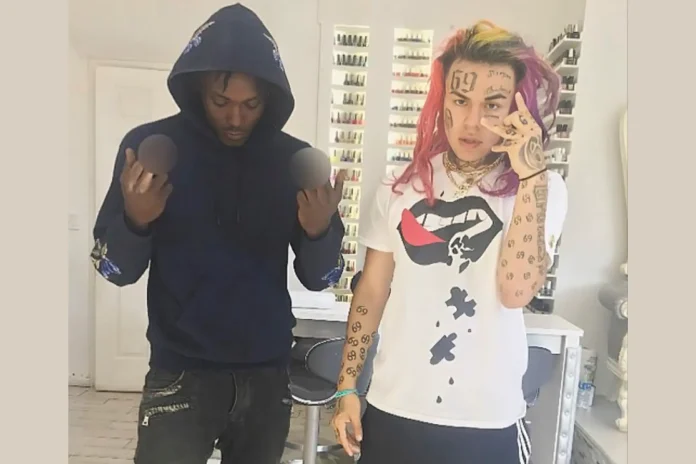
Brooklyn rapper Kooda B is taking his former friend 6ix9ine to federal court, claiming years of accusations that he cooperated with federal investigators have damaged his music career and put his family in danger.
Kooda B, whose real name is Kintea McKenzie, filed a 48-page defamation lawsuit against Daniel Hernandez, professionally known as 6ix9ine, on October 16, 2026, in the U.S. District Court for the Eastern District of New York. According to the complaint, he is seeking more than $150,000 in damages, a jury trial, and an injunction preventing 6ix9ine from repeating the allegedly defamatory statements.
The lawsuit, identified as McKenzie v. Hernandez, case number 1:2026cv06677, centers on allegations that 6ix9ine repeatedly portrayed McKenzie as a federal informant who identified the person responsible for the 2018 shooting targeting Chief Keef.
The two rappers were once close associates in Brooklyn’s hip-hop scene. Their relationship was even reflected in 6ix9ine’s 2017 track “Kooda,” which was named after McKenzie, who also appeared in its music video.
However, their relationship deteriorated following the federal investigation into the Nine Trey Gangsta Bloods.
The dispute now involves the June 2, 2018, shooting outside Manhattan’s W Hotel in Times Square. Federal prosecutors established that McKenzie helped arrange the attack after accepting money from Hernandez. Another individual fired the weapon, and Chief Keef was unharmed.
McKenzie pleaded guilty in June 2019 to assault with a dangerous weapon in aid of racketeering. He received a 54-month prison sentence in December 2020.
Importantly, admitting his role in arranging the shooting does not establish that he identified the shooter to investigators.
The complaint highlights several alleged statements, including an August 2021 Clubhouse appearance where 6ix9ine reportedly said, “Kooda B told the feds who really shot the gun.”
It also references a September 2025 appearance on One Night with Steiny and a VladTV interview.
McKenzie argues that these accusations contradict his criminal case records. According to the complaint, prosecutors acknowledged that he “could have implicated the others involved in this reckless shooting” but “he did none of these things.”
The filing also states: “At no time did Plaintiff identify the shooter.”
Kooda B claims the repeated accusations cost him music opportunities, damaged industry relationships, and triggered online harassment and death threats against him and his family.
The DoJ record review also shows McKenzie’s guilty plea as well as his participation in the shooting organization. The interpretation of the complaint as to the defendant’s cooperation still forms the core of the civil issue.
The federal docket proves the existence of such an application but there are no further rulings found in the records till November 18. No official reaction from 6ix9ine was found too.
In the end, the question is much more important than the $150,000 claim: Does Kooda B really cooperate with federal authorities or is his reputation ruined because of the repeated allegation about this while having criminal records stating his non-cooperation?

