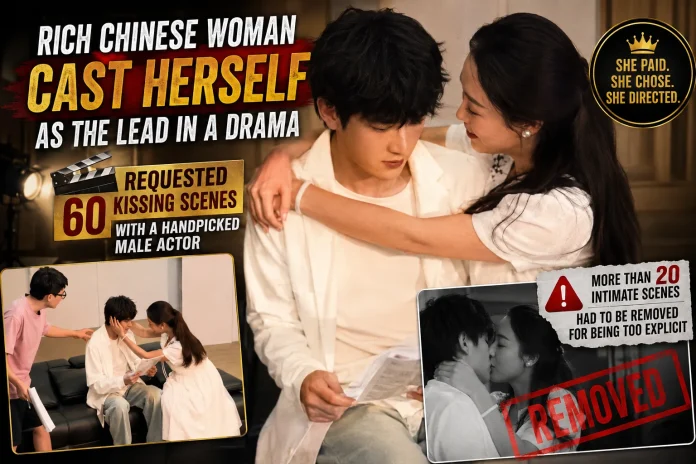
A wealthy Chinese investor financed her own short-form drama, cast herself as the female lead, and ordered more than 60 kissing scenes with a young actor she personally selected. The finished product barely survived its premiere.
In late 2025, an unnamed woman from Zhejiang fully funded a roughly 50-episode ancient-costume microdrama titled The Fallen Prince. She took the role of the princess consort and chose rising actor Zhong Yufei, then about 23, to play the disgraced prince opposite her. Director Meng Xing was hired to deliver the custom project. The original script called for only about a dozen kissing scenes. Once the investor stepped on set, that number climbed past 60 through repeated rewrites. Crew members joked that the pair were required to kiss every few steps.
Meng and the writing team pushed back, arguing the volume would wreck the pacing and invite problems with platform censors. The investor overruled them. Zhong later said that as a relative newcomer facing someone who controlled both the budget and the lead role, he felt he had little room to object. In a video statement, he described intimate sequences that crossed professional lines, including unwanted tongue contact and the repeated transfer of saliva during kisses. He said he stayed quiet on set to avoid being labeled difficult and only later asked the production team to limit the intensity.
After filming, the streaming platform cut more than 20 of the intimate scenes for being too explicit. The heavy edits left the storyline disjointed. The drama aired for only a few days before it was pulled. The investor then withheld the final production payment of about 30,000 yuan, blaming the cuts and the show’s reception on the creative team rather than the scenes she had demanded.
The unpaid balance prompted Meng to go public. Zhong followed with his own account, confirming both the escalation of the kissing scenes and the on-set boundary issues. Online conversation quickly turned to the power imbalance that arises when a financier also performs and dictates creative decisions. Secondary rumors about a personal relationship between Zhong and the investor circulated briefly; he and his representatives denied them.
The episode has become a clear example of the risks inside China’s fast-growing short-drama sector, where private capital can leave junior actors with limited leverage. Production sources have said they intend to introduce clearer contractual protections for performers going forward. The investor’s identity has not been confirmed in major reporting, and the payment dispute remains unresolved in the public record.