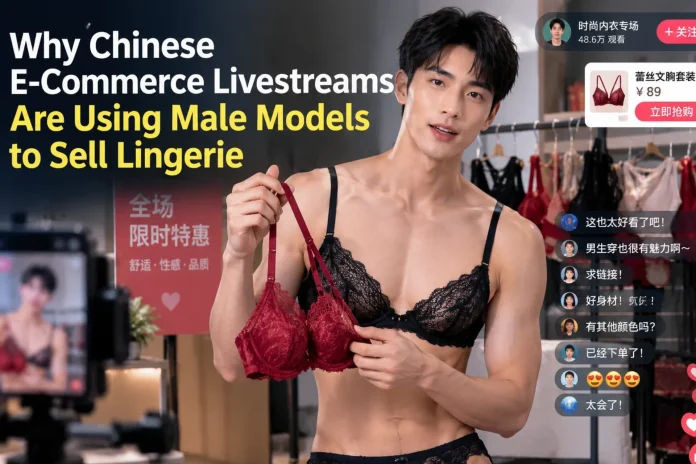
In late 2022 and early 2023, Chinese online shoppers scrolling through livestreams on Douyin and Taobao Live encountered an unexpected sight: men confidently modeling women’s bras, corsets, lace nightgowns, and silky slips.
The reason was not fashion experimentation or social commentary. It was a practical response to China’s strict online content rules.
Livestream shopping had become a commercial powerhouse in China, with the sector projected to exceed US$700 billion in 2023 and accounting for roughly 10 percent of the country’s total e-commerce revenue. Hosts demonstrating products in real time—especially clothing—drove strong sales. Lingerie was particularly well-suited to the format, as viewers could see fit, fabric, and style on a body.
But the same visual appeal that made lingerie effective for livestreams also triggered China’s censorship system. Rules against spreading “obscene” or vulgar material have long restricted women from appearing in revealing clothing during broadcasts. Female models wearing bras, corsets, or nightgowns risked having their streams abruptly terminated. In some cases, accounts faced temporary or permanent bans. Several lingerie sellers reported their sessions being cut short in late 2022 and early 2023 after featuring female models.
Faced with repeated disruptions, sellers looked for a workaround. The solution proved straightforward: put male employees or hired models into the exact same women’s garments.
One of the earliest and most cited examples came from a business owner identified in Chinese media only as Mr. Xu. In December 2022, his company livestreamed a male model wearing a silky robe on Douyin under a caption that translated roughly as “The light and luxurious boudoir of the wife and adults.” The video attracted more than 2,000 likes and hundreds of comments. Xu later explained the decision without irony.
“Personally, we don’t really have a choice. The designs can’t be modelled by our female colleagues, so we will use our male colleagues to model it,” he told Jiupai News. He added that the approach was not intended as sarcasm or protest: “Everyone is being very serious about complying with the rules.”
Other sellers quickly followed. Videos circulated showing men in push-up bras, tight corsets, black lingerie sets, pink slip dresses accessorized with cat-ear headbands, and white dress-and-robe combinations. In some streams, a male model stood beside a mannequin wearing a similar outfit or next to a female host dressed more conservatively in pajamas. The visual contrast underscored the practical nature of the strategy: the products were still being shown, but without triggering the same automatic enforcement.
Public reaction on Chinese social media was mixed but largely amused. Commenters on Douyin noted that “the guy wears it better than the girl.” Others treated the practice as logical problem-solving. “So what should I do if I want to showcase lingerie in the live broadcast session? It’s very simple, find a man to wear it,” one Weibo user wrote. Some critics argued that the shift reduced modeling opportunities for women. Xu pushed back, pointing out that many livestream directors were themselves women and questioning whether that also constituted taking jobs from men.
Alternative approaches also appeared. Some female models tried wearing lingerie over T-shirts to stay within platform rules. Others relied more heavily on mannequins. The male-model method stood out because it retained the dynamic, personable style of livestream selling that had proven commercially effective.
The phenomenon was not entirely without precedent. Male hosts had already succeeded with traditionally female products—most notably Austin Li Jiaqi, known as China’s “Lipstick King,” who built a massive following by demonstrating lipstick. The lingerie cases simply extended the gender swap into intimate apparel under sharper regulatory pressure.
By early March 2023, the story had drawn international attention as a vivid illustration of how Chinese internet businesses often adapt around censorship rather than confront it directly. Strict rules made female lingerie modeling commercially risky. Male models wearing the identical items kept the streams running, the products visible, and the sales flowing—while remaining formally compliant with the letter of the regulations.
The result was one of the more surreal and pragmatic workarounds to emerge from China’s tightly controlled digital marketplace.