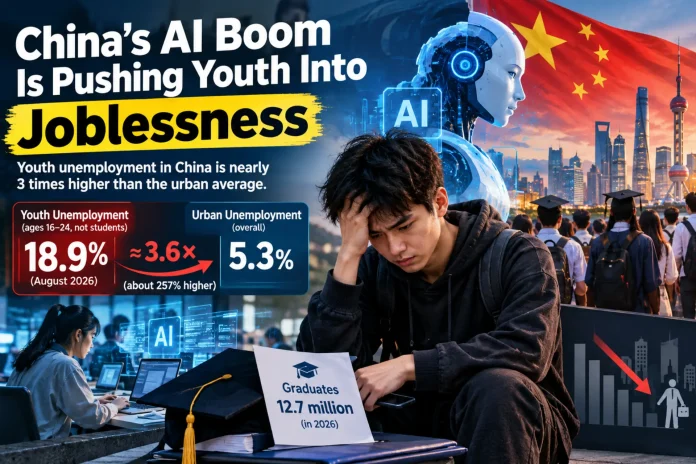
An image captioned with the alleged shocking truth of how fast-paced China’s development of artificial intelligence is driving the nation’s youth into joblessness, almost three times as much higher than the average urban unemployment of China, is currently trending on social media.
These numbers aren’t made up. According to the National Bureau of Statistics of China, the surveyed unemployment rate among individuals aged between 16 and 24 years without being students was recorded as 18.9% in August 2026. The overall surveyed unemployment rate in China’s urban areas was 5.3%. This makes the youth unemployment number about 3.6 times higher (approximately 257%) than the urban unemployment average.
The situation with the AI aspect is more complicated. The adoption of artificial intelligence in China is proceeding at a rapid pace and is supported by the authorities. AI is being applied in all sectors and industries to perform basic repetitive tasks for junior specialists in programming, data analysis, content creation, and customer service. The need for narrowly specialized AI engineers and data analysts has increased. However, various analyzes highlight other factors that have a significant impact on the labor market.
First of all, a record-breaking number of 12.7 million graduates entered the Chinese labor market in 2026. Moreover, there is a decrease in the domestic market due to a long-standing property sector crisis, imbalances caused by the mismatch between the skills of graduates and job requirements, and seasonal trends. For example, the number of job openings peaks in summer with the arrival of new graduates. Thus, the joblessness rate in China for June was 14.9%, while in July, it rose to 17.9% and 18.9% in August.
The series of China’s youth unemployment rates stopped its decline in mid-2023. The current indicator does not include students in the working-age population, while the previous series did. Thus, the two series are not comparable, but the OECD concluded that there is no evidence that AI affects the labor market situation of young people and deteriorates it due to various factors. The IMF spokesperson said that the problem was due to cyclical and structural imbalances and the downswing in the business cycle several years earlier, and this trend is unrelated to the recent advances in technology.
The Chinese government is taking measures to counteract the situation by accelerating the “employment-first” policy from the 15th Five-Year Plan, improving skills through enhanced training funds, and adjusting the curriculum, and providing more specialist knowledge in narrow AI, and expanding the search for new employees. However, the growth in the number of graduates, combined with an overall decrease in employment rates, has led to an increase in the youth unemployment rate in China.