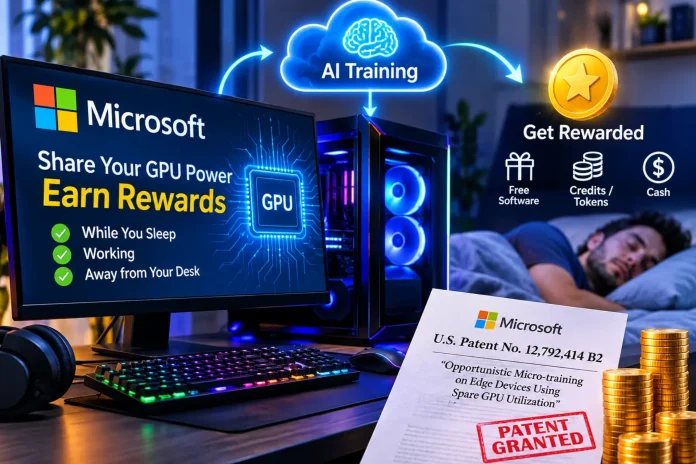
What if your gaming computer could potentially earn you money while you’re sleeping, working, or away from your desk? Microsoft has secured a patent for technology that would let people share unused GPU power from gaming PCs, laptops, and other personal devices to help train artificial intelligence and possibly get rewarded for it.
The patent, granted as U.S. Patent No. 12,792,414 B2 on November 10, 2026, covers a system called “Opportunistic Micro-training on Edge Devices Using Spare GPU Utilization.” Microsoft Technology Licensing, LLC filed the application on April 30, 2025. It was first published November 5, 2026, as US 2026/0349820 A1. The sole inventor is Aditya Vasanth Challapally of San Francisco.
The concept is simple. Massive AI tasks training are divided into small, independent “microtasks.” The system keeps an eye on the available computing resources of the devices involved in the process based on monitoring GPU/CPU performance, memory usage, heat, and power consumption. When a device has enough capacity and is cool, it can start working on the task. But if you start a heavy application or game, then it will stop it automatically.
Participation would be opt-in only. Results would be checked across multiple devices for accuracy, and devices could earn reliability scores based on past performance.
The patent description notes that the system
“may track the amount of computations each edge device has provided and may compensate the owners.”
Credits could potentially be exchanged for free software, access to the trained model, money, or similar benefits. FourWeekMBA reviewed the filing and found that none of the 20 formal claims specifically cover paying or compensating owners the compensation language appears only in the descriptive text as a possible example.
There have been no announcements regarding any program details, rate of payment, release date, or registration process from Microsoft. Claims regarding any Microsoft Store credits or AI tokens exceed the scope of information provided by the patent.
Electricity expenses will increase due to additional GPU load. Issues of equipment degradation, temperature, and fan lifetime are legitimate regardless of thermal protection measures. Privacy and cybersecurity issues will be inherent to any system that tracks hardware statistics and uses external load, but participation according to the patent is voluntary with explicit permission.
The idea resembles volunteer systems such as Folding@home that uses the potential of personal computers for science research for years. The only difference is a business-oriented approach to artificial intelligence and optional incentive mechanism.
For now, this remains a technical idea on paper. Whether Microsoft ever turns it into a real service and whether the rewards would make the power bill and hardware stress worthwhile remains an open question. Gamers and PC enthusiasts will be watching closely.