

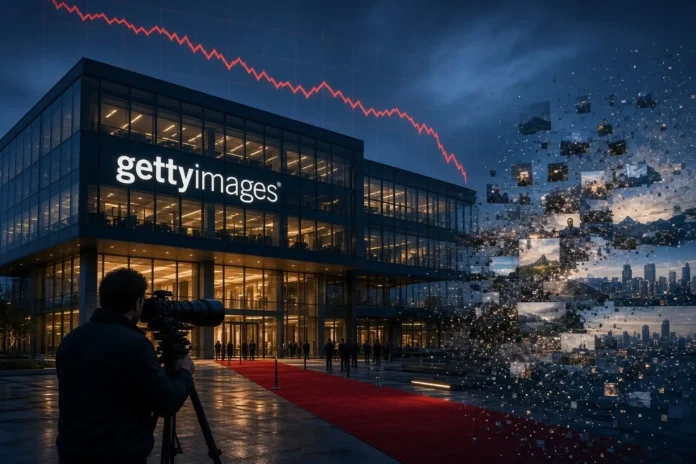
Getty Images has filed for Chapter 11 bankruptcy protection, a move that will take the longtime visual-content giant private and wipe out its public shareholders as it grapples with heavy debt, a collapsed merger, and the steady erosion of its stock-photo business by generative AI.
The company submitted its voluntary petitions on Oct. 21 in the U.S. Bankruptcy Court for the District of Delaware, formalizing a prepackaged restructuring it first outlined nine days earlier. Only certain U.S. entities are in the case. Foreign operations sit outside it. In the filings, Getty estimated both assets and liabilities in the broad $1 billion to $10 billion range. At the time of the petitions, funded debt stood at roughly $1.46 billion, a stack that included high-interest secured notes, unsecured notes, term loans, and a fully drawn $150 million revolver. Cash had fallen to around $50 million.
The company returned to the public markets in 2022 via a SPAC deal that left it leveraged. Last year it tried to solve the next set of problems by agreeing to buy rival Shutterstock in a transaction valued at about $3.7 billion, a combination both sides framed partly as a response to AI tools that can spit out generic commercial imagery on demand. U.S. regulators cleared it without conditions. The U.K.’s Competition and Markets Authority did not. In May the CMA said the deal could go forward only if Shutterstock sold its entire global editorial business. Getty’s board rejected that path and terminated the agreement in early July after spending more than $100 million on the effort.
At the same time, litigation over warrants issued in the SPAC transaction delivered a sudden cash hit. Courts ruled that Getty had improperly blocked exercises when the stock briefly surged. One set of judgments totaling roughly $110 million plus interest was paid earlier this year after appeals failed. Another judgment of about $92 million remains unpaid. The company’s bankruptcy lawyer told the Delaware court that existing judgments already approached $200 million, with potential further exposure up to $275 million and tens of millions spent on legal fees. Those claims are expected to be eliminated or subordinated under the plan.
Generative AI is the longer-term pressure that made the debt harder to carry. Getty’s own reports have noted that customers can now choose AI-generated content instead of licensing traditional stock. The Creative and iStock sides of the business, which lean on generic commercial images, have felt it most: subscriber numbers have declined and growth has flattened while overall revenue has slipped modestly in recent quarters. Editorial and news imagery, where provenance and authenticity still carry weight, has held up better. Getty has sued AI developers over training data and has also signed deals to supply licensed images to some generative platforms. The immediate crisis, though, was the combination of debt service, merger costs, and the warrant judgments that drained cash.
Under the restructuring support agreement reached Oct. 12, affiliates of the Getty family and Koch Equity Development will put in up to $533 million in new equity and own the company outright once it emerges. Unsecured noteholders have agreed to retire about $270 million of notes for roughly $170 million in cash. Secured lenders accepted lower rates and longer maturities. The plan aims to cut total funded debt by more than $500 million and sharply reduce annual interest expense. Koch is also supplying up to $143 million in debtor-in-possession financing. Existing public shares will be canceled. Getty expects to complete the process by the end of the year.
The company has been consistent that day-to-day operations will not change. Customers, contributors, employees, partners, and vendors are unaffected, and ordinary payments, including royalties, are expected to continue on schedule. CEO Craig Peters described the filing as a procedural step to implement a balance-sheet fix that will support future investment in content. Chairman Mark Getty has called the family and Koch commitment a sign of confidence in the long-term value of authentic visual archives.
For photographers who license through Getty or iStock, the practical result is continuity. For anyone who bought the public stock after the 2022 listing, the recovery is zero. For the rest of the stock-photography business, the episode shows how quickly generative tools can compress pricing on generic work while leaving specialized editorial and historical material more durable. Getty will come out the other side private, lighter on debt, and still one of the largest holders of premium visual content, operating in a market that no longer looks like the one that existed when it went public four years ago.

