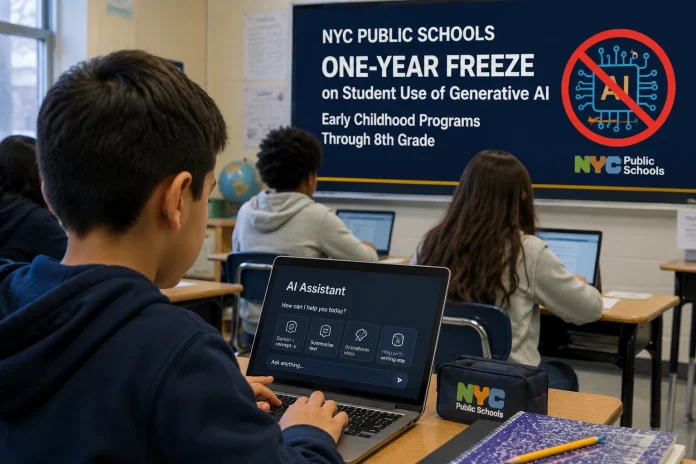
New York City Public Schools is putting a one-year freeze on student use of generative AI from early childhood programs through eighth grade, Mayor Zohran Mamdani and Schools Chancellor Kamar Samuels announced Wednesday.
The moratorium, effective for the 2026-2027 school year that begins next week, will affect roughly 600,000 students — about two-thirds of the system’s enrollment. It prohibits student-facing generative AI tools, including chatbots, AI tutors, and instructional software that relies on the technology. Companion chatbots designed for social or mental health support are banned across all grade levels.
“Children need teachers and human connection in order to learn and grow,” Mamdani said in a statement. “They need to develop skills alongside their peers, build relationships with educators, and wrestle with tough problems on their own. The tech industry wants us to believe that AI-powered early education is not only inevitable, but necessary. We do not see it that way.”
Officials framed the policy as a deliberate pause to prioritize hands-on learning, social interaction, and independent thinking for younger students while the city studies the technology’s impacts.
Strict Limits on Screens and Devices
The AI restrictions come paired with new limits on individual digital devices:
- Students in 2-K through second grade will not be given individual laptops or tablets in class. Shared classroom technology such as smartboards remains permitted.
- Grades 3–5 face a recommended daily limit of about 30 minutes of individual screen time.
- Middle school students (grades 6–8) face a recommended cap of about 45 minutes per day.
City education officials wrote in an internal presentation that “younger students need hands-on learning, social interaction, play, and teacher-guided instruction. Routine individual screen use can crowd out those experiences.”
Restricted Access in High School
High school students will face tighter but not total restrictions. All high schoolers will receive AI literacy lessons twice a year covering how the technology works, its biases and risks, ethics, and how to evaluate its outputs critically. Limited use will be allowed for AI literacy and certain career-readiness or certification programs.
A small pilot program will operate in a limited number of high school classrooms using pre-vetted tools that meet strict safety and data privacy standards. Those tools include time limits and are designed to keep students as the primary thinkers. Named examples include Quill for English support, Edia for math, Brisk Teaching for study practice, and multi-subject platforms from Playlab and Intel.
Rules for Teachers
Educators retain more flexibility. Teachers may use approved AI tools for lesson planning, organizing ideas, drafting non-sensitive communications, and translating materials.
They are barred from using AI for grading, making decisions about student placement, discipline, promotion or graduation, counseling or crisis management, developing IEPs or 504 plans, or monitoring student behavior.
Exceptions and Enforcement
Exceptions exist for assistive technology serving students with disabilities and English language learners, as well as for coding assignments, robotics, e-books, and required computer-based assessments in reading and math.
Exact enforcement details were not fully spelled out in Wednesday’s announcement. A coalition of parents, students, teachers, union representatives, elected officials, and outside experts will help evaluate the one-year pause and shape longer-term policy for the 2027-2028 school year and beyond.
Path to the Decision
The new rules mark a significant tightening after months of debate. In March, the Department of Education released preliminary “traffic light” guidance that drew sharp criticism from parents and a majority of City Council members, who warned about risks to cognitive development, critical thinking, mental health, and privacy. Thousands of parents signed petitions calling for a broader moratorium.
Chancellor Samuels later acknowledged the earlier guidance “missed the mark.” In July, the department ordered a temporary freeze on new education technology purchases while finalizing the stricter approach.
“This moratorium is a commitment to getting the future right,” Mamdani said. “We will embrace new technology, but only when it serves our students.”
Schools reopen on September 10. The policy represents one of the most restrictive stances taken by a major U.S. school district on generative AI in the classroom.