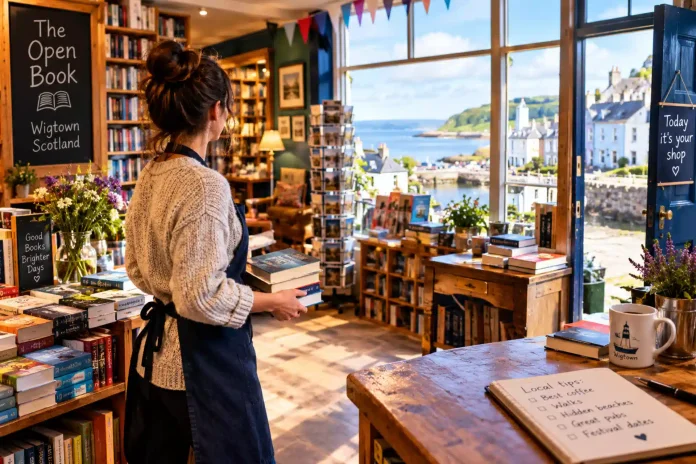
What if your next Airbnb vacation came with the keys to an actual bookstore?
It’s real. In Wigtown, Scotland officially Scotland’s National Book Town paying guests at The Open Book stay in a self-catering apartment above a working second-hand bookshop and take the reins of the store for their entire visit. The official Airbnb listing and the Wigtown Festival Company make clear this is a holiday experience, not a job: guests pay for the stay, receive volunteer support, and treat the shop as their temporary domain.
Guests set their own opening hours (typically around six days a week), rearrange displays and window presentations, re-categorize books, influence prices with guidance, and host small events. Past visitors have organized quizzes, author talks, karaoke, treasure hunts, tea parties, music sessions, and wine tastings. The space holds roughly 12–15 people theatre-style. Previous guests leave journals full of tips and local recommendations. A local volunteer, often Joyce Cochrane, welcomes arrivals and helps introduce them to the community.
Wigtown, a small coastal town in Galloway with multiple independent bookshops and an annual literary festival, earned its National Book Town designation in 1998. The Open Book fits the town’s literary identity perfectly. It launched in August 2014 as a creative residency for writers, musicians, and artists. After about six months it opened to the public as the “bookshop holiday.” Author Jessica Fox, who moved to Wigtown after falling in love with the place, helped conceive the project. Local couple Rosemary and David Bythell bought the building; the non-profit Wigtown Festival Company runs it with volunteer support.
Media attention, including an early BuzzFeed piece, turned it into an international curiosity. By March 2026 more than 550 guests had stayed. The rate sits at approximately £175 per night for typical stays of six to 14 nights. Bookings run through February 2028 in many reports, with new dates released monthly about 23 months ahead. Cancellations create occasional openings via a notifications list. One estimate of the waitlist backlog roughly 119 years at current throughput is an illustration of demand, not a literal queue.
The project contributes around £10,000 a year to the Festival Company’s charitable work, including children’s festivals and education programs for local schools. Organizers emphasize it complements rather than competes with other local bookshops. As Jessica Fox has put it, people are drawn by the “what if” of living out a bookseller fantasy for a short while.
For American readers, this stands out as pure cultural tourism: a chance to slow down, meet locals, and briefly own the day-to-day rhythm of a real independent shop in one of Scotland’s most bookish corners. Demand remains sky-high, so timing and patience matter.
Would you pay for a vacation where you get to play bookstore owner for a week?