

A 23-year-old man from Szczecin, Poland, sat in pre-trial detention Friday facing up to eight years in prison after Poland’s Central Bureau for Combating Cybercrime (CBZC) charged him with persistent harassment and criminal threats, alleging he used cash-on-delivery food orders to torment strangers across four Polish cities — a delivery-app fraud scheme in the same family. The case is now exposing a gap in Polish fraud law that one of the country’s lawmakers wants closed.
Officers from Poland’s Central Bureau for Combating Cybercrime arrested him at his home in mid-August after an investigation supervised by the District Prosecutor’s Office in Szczecin. They seized phones, data drives, and other devices they say were used to place the orders. A court ordered two months of pre-trial detention; he can be released if he posts a 10,000-zloty surety.
The man has not been publicly named. He was charged with persistent harassment and making criminal threats. CBZC’s Aug. 17 notice says he denied the charges — a stalking-via-address pattern that authorities are increasingly tracking. Prosecutor Artur Mądrzak said the suspect gave a lengthy statement whose details investigators are still checking.
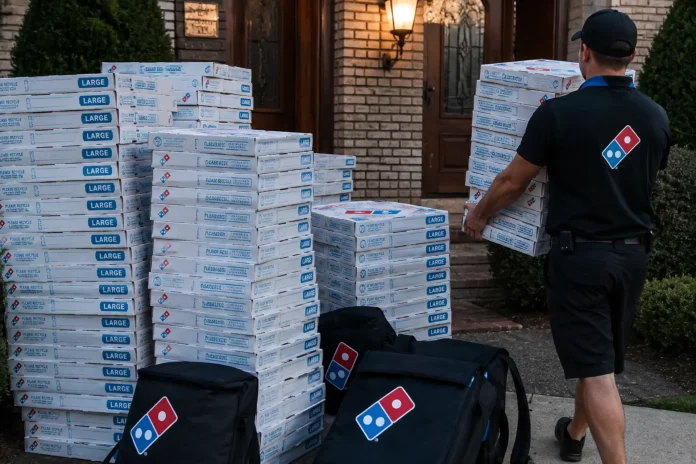
The scheme, as police describe it, ran with names, phone numbers, emails, and delivery addresses that kept changing on every ticket. Recipients were private residents and, in some cases, public figures from Polish politics and media. CBZC says at least one order exceeded 37,000 zloty, roughly €8,572. Another restaurant received a request for 300 pizzas and canceled it because the kitchen could not produce that volume. Most deliveries were aimed at Szczecin, but investigators logged more than a dozen similar cases in Warsaw, Kraków, and Wrocław.
People listed as customers did not know an order had been placed in their name. Drivers still showed up asking to be paid.
The comments attached to some orders are what pulled the case out of the prank category. Senior Constable Michał Pietraszko of the CBZC press team told Polish outlet Szczecin.se.pl on Aug. 20 that the notes included details that, in the bureau’s view, only the targets or people close to them would know. The same fields carried threats: kidnapping a minor, setting fire to a notary’s office, causing a traffic crash. Multiple recipients received threats of that kind.
Mądrzak said that in one instance the suspect allegedly offered to stop if a victim withdrew a criminal complaint.
According to Polish outlet TVN24, the names used on order forms included television presenter Hubert Urbański and musician Maciej Maleńczuk. Those particular deliveries were not filled because the restaurant spotted them as fake.
A pizzeria on Gdyńska Street in Szczecin was among the targets, according to Radio Eska reporting republished by Szczecin.se.pl. Its owner, Michał Kowalski, told the station that his staff fulfilled two of the early orders before growing suspicious and calling the named recipients directly, who said they had ordered nothing. Had every fake order been fulfilled, Kowalski said, the shop could have lost roughly 10,000 zloty; in the end, losses were limited to the value of a few prepared meals.
Lawmakers have already used the case to poke at a gap in Polish fraud law. Dariusz Matecki, a PiS member of parliament from Szczecin, filed an interpellation with the justice minister after the arrest. Article 286 of the Polish Criminal Code requires an intent to obtain a financial benefit. A person who places a fake order only to harass someone or wreck a restaurant’s night may not fit that frame. Matecki asked prosecutors which statute they are using and proposed expanding fraud to cover harm inflicted for its own sake, according to posts on his Facebook page and website.
The charges now on the docket are harassment and criminal threats, each carrying a maximum of eight years if a court convicts — a penalty that has driven other harassment cases into major settlements. Investigators have not stated a motive, and Dexerto and Euronews both reported that point as still open.
Joint work by the CBZC and the Investigative Department of Szczecin Municipal Police Headquarters led officers to the apartment. The bureau posted a notice of the detention on Aug. 17. Polish media first published the full account four days later.
Restaurants that spotted oversized tickets in time avoided the worst of the loss. The people whose names, family details, and home addresses appeared on the slips did not get that choice. They found a driver at the door, or a threat in a comment field, and a bill they never asked for.

