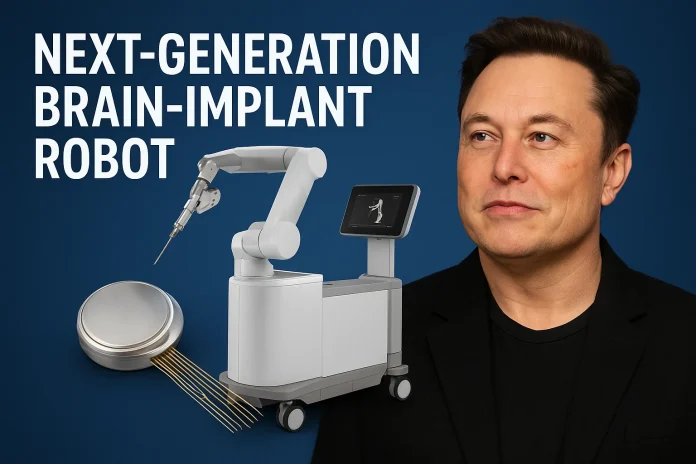
Elon Musk’s Neuralink is taking a giant leap in brain-computer interface technology with the announcement of its next-generation surgical robot, R1, designed to implant the company’s coin-sized N1 neural chip. The upgrade, revealed during Neuralink’s Summer 2025 Update, promises to transform what was once a painstaking, hours-long procedure into a surgery that resembles the ease of LASIK eye operations.
Founded in 2016, Neuralink aims to create high-bandwidth links between human brains and computers. Initially focused on restoring autonomy for people with paralysis or neurological disorders, the company now envisions broader applications—including enhanced cognition and direct mind-to-device control.
The new Gen 2 R1 robot is a significant upgrade over the Gen 1 model used in early 2024–2025 trials. Among the improvements:
- Speed: Threads are now inserted in just 1.5 seconds each—11 times faster than before.
- Depth: The robot can reach over 50mm into the brain, targeting deeper structures such as the thalamus and basal ganglia, which opens doors for pain modulation and mood regulation.
- Accessibility: The device now fits nearly 99% of skull shapes, up from 70–80%, thanks to a database of 10,000+ CT scans.
- Cost Efficiency: Disposable needle cartridges have dropped from over $1,000 to about $50 per use.
- Precision: Sub-micron accuracy (0.05mm) ensures minimal tissue damage, guided by AI-assisted stereotactic arms.
Neuralink’s team demonstrated that the full 64-thread array can be inserted in under two minutes, a dramatic improvement from the 18-plus minutes required previously.
How the Procedure Works
The R1 is a cart-sized robot used in certified hospitals. The process includes:
- Pre-op mapping: AI selects optimal insertion sites using MRI/CT fusion.
- Surgery: A small, sculpted incision is made in the skull, and threads are inserted with real-time imaging confirming placement.
- Implantation: The N1 chip, a hermetically sealed titanium device, is anchored subcutaneously and wirelessly linked to external apps.
- Post-op calibration: Neural signals are decoded and integrated within 1–2 weeks.
Thanks to these upgrades, procedure times have decreased from 4–8 hours to under an hour, with complication rates of less than 1% in 2025 trials.
Patients Are Already Seeing Results
Early users have reported remarkable outcomes. Noland Arbaugh, the first human recipient of the N1 implant, can now control cursors, play video games, and even design 3D models using only his mind. Another ALS patient can communicate outdoors and operate robotic arms via the implant. Neuralink is currently expanding trials across the U.S., Canada, and the U.K., with plans to scale up dramatically.
Neuralink’s progress raises both excitement and concern. Advocates see a future where patients regain independence and enhanced cognitive abilities become possible. Critics worry about privacy, potential misuse, and social inequality. Neuralink emphasizes patient-owned data and encryption to address these issues.
The company also outpaces rivals like Synchron, whose stent-based implants offer less invasiveness but lower bandwidth. Musk has teased broader applications, including controlling Teslas with thought, potentially as soon as 2026.
As one analyst summarized, “This isn’t just medicine—it’s the race for neural dominance.”