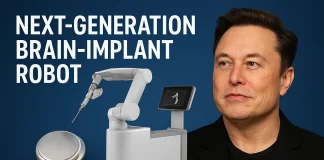
Imagine drifting across a digital racetrack, steering with nothing but a flicker of intent from your mind, while a friend races neck and neck beside you.
That vision became a reality this week when two men with severe paralysis squared off in head-to-head matches of Counter-Strike 2 and Mario Kart, controlling every move through Neuralink’s N1 brain implant alone. Their sessions mark a quiet revolution in how we reclaim joy from the edges of loss, blending raw human will with seamless technology to rebuild worlds that have been shut out for a long time.
These competitors, both early volunteers in Neuralink’s ongoing PRIME Study, have spent over a year adapting the coin-sized N1 device, which is embedded in their brains. The implant taps into the motor cortex, decoding thoughts of hand gestures or eye movements into precise digital commands with a latency of less than 100 milliseconds. What started as solo trials in chess and web browsing has now evolved into full multiplayer battles, where one player imagines flexing fingers to navigate maps in Counter-Strike 2. At the same time, the other locks their gaze for aiming and pulses their focus to fire. From their homes across the U.S., they log hours of play without caregivers or travel, turning what was once isolation into shared triumphs over virtual battlefields and rainbow roads.
The PRIME Study, which began human trials in January 2024 after FDA clearance, targets adults with quadriplegia from spinal cord injuries or ALS. Volunteers undergo a quick robot-assisted surgery at sites like the Barrow Neurological Institute in Phoenix, where ultra-thin threads thinner than hair weave into brain tissue to capture signals. Post-operation, an app guides calibration, mapping imagined actions to controls, such as accelerating in Mario Kart or reloading in shooters. By late 2025, refinements have boosted thread stability to over 95 percent, minimizing early glitches and enabling more than 30 hours of weekly use split between research and leisure. This expansion now includes global partners in the UK and Canada, with two dozen participants pushing the technology toward everyday reliability.
Meet the duo behind the demos: one is Noland Arbaugh, a 31-year-old from Missouri whose diving accident in 2016 left him paralyzed from the shoulders down. As the study’s first implant recipient, he traded late-night frustration with mouth sticks for fluid cursor control, often clocking 12-hour gaming marathons that outpace able-bodied friends. His partner, known publicly as Alex, joined in mid-2024 after his own spinal injury robbed him of mobility; a former mechanic, he now designs 3D models alongside fragging opponents in Counter-Strike 2. Both in their late 20s or early 30s, they embody the study’s focus on young adults hungry for independence, selected for these showcases due to their quick mastery of complex inputs. Privacy shields their full stories, but their progress echoes a broader cohort finding purpose in pixels.
In one highlight, they dueled in Mario Kart, hurling green shells and drifting corners with thought alone, often landing in top-three spots against live opponents. Counter-Strike 2 presented sharper challenges, requiring dual-joystick simulation for strafing and sniping, all decoded from neural bursts at over 1,000 signals per second. Beyond competition, feats like streaming sessions or chatting mid-game weave social threads that have been frayed by years of stillness. These aren’t scripted stunts but organic routines, with users reporting a 50-50 balance of leisure and tasks that slash reliance on helpers. The technology’s wireless charging and app integration make it as routine as a phone update, fostering a rhythm of play that feels profoundly ordinary.
This leap underscores Neuralink’s promise in high-bandwidth interfaces that don’t just restore control but amplify connection, a core human drive often dimmed by paralysis. As someone who covers technology’s intersection with daily life, I see these sessions as more than milestones; they challenge us to rethink accessibility, ensuring innovations like the N1 implant prioritize equity over spectacle. Yet, balance demands noting hurdles: ethical questions around data privacy persist in our thoughts, even as safety records show rare infections and swift recoveries. Ongoing trials aim for six-year tracking, with lifetime access for participants, signaling commitment to long-haul impact.
Looking ahead, these gaming wins hint at broader horizons, from piloting robotic limbs to decoding speech for the voiceless. With over 300,000 quadriplegics in the U.S. alone facing similar voids, the stakes feel urgent. Neuralink’s roadmap, detailed in their PRIME Study overview, aims to scale to blindness aids and beyond, potentially aiding five million people worldwide, according to health experts. For now, though, it’s the laughter in a virtual victory that lingers, proof that minds unbound can still chase the thrill of the game.