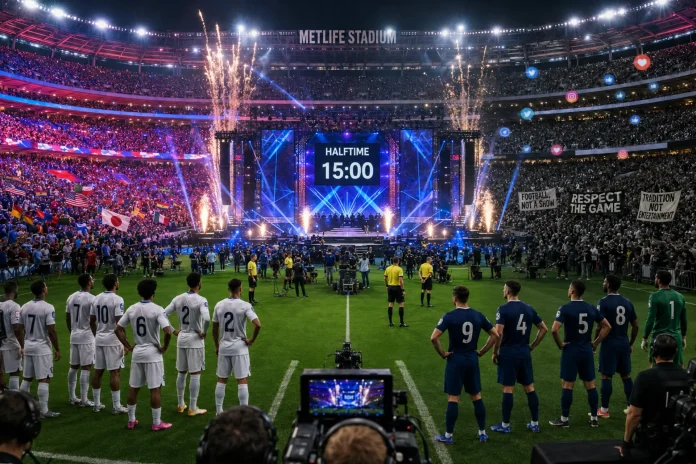
Could this be the transformation of the largest soccer game in the world into America’s greatest show in town? The news that FIFA is going to make changes to the 2026 World Cup Final, held at MetLife Stadium, regarding the duration of the halftime period has become a viral sensation.
The very first halftime show for the World Cup like that of the Super Bowl will be arranged by FIFA in the year 2026 on July 19 in MetLife stadium, New Jersey. The broadcasters have prepared for a duration of 20-30 minutes, unlike the usual 15 minutes to accommodate a 11-minute performance and stage setting and tearing, along with television commentary.
It has been arranged by FIFA President Gianni Infantino to provide some entertainment value to increase attendance and raise the bar for the American-hosted tournament. This event, being held in collaboration with Global Citizen, plans to raise $100 million to educate children using the FIFA Global Citizen Education Fund.
Artists include Madonna, Shakira, BTS, Justin Bieber, Burna Boy, and many others, while Chris Martin from Coldplay will curate the performance. Gustavo Dudamel will conduct the performance of PS22 Chorus. The pre-game closing ceremony will be done with artists including Robbie Williams, Tom Cruise, Nicole Scherzinger, and iShowSpeed.
This builds on recent experiments. Shakira performed at the Copa America Final in 2024 at the stadium located in Miami. On the other hand, the halftime interval for the 2025 FIFA Club World Cup was approximately 24 minutes in the same stadium.
Under IFAB Law 7, players are entitled to a halftime interval not exceeding 15 minutes, though competition rules can specify the duration and it may be altered with the referee’s permission. FIFA frames the change as a special, final-only arrangement rather than a permanent shift for all matches.
It has received considerable backlash for “Americanization” of football, possible effects on players’ health from extended idleness, and prioritization of money-making over traditions. People in social media made jokes about delaying returns and questioned the change in favor of entertainment. Television networks such as BBC will concentrate on analysis but not broadcast the entire show.
Proponents of the idea say that it is the way to make it more relevant to today’s audiences and make it attractive commercially in North America.
This unique show at the 2026 final may become a point of no return for top-level football in terms of its further development into a combination of sport, entertainment, and culture in an ever-growing media environment. With the July 19 beginning approaching, it becomes obvious that there are far-reaching issues at stake.