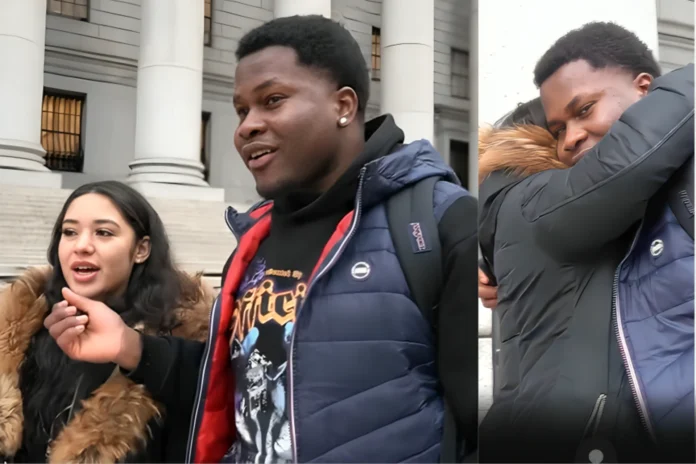
YouTuber AMOLZ, whose channel is built on provocative street content and high-drama bailout videos, is once again facing criticism after releasing a new episode in which he pays a $10,000 bond to free Talia, a 25-year-old Guatemalan immigrant detained by ICE. The video, posted to his YouTube channel, documents Talia’s release and her first meal outside detention—a McDonald’s run where AMOLZ interviews her about her past, her family’s escape from cartel violence, and her expectations for dating.
In the video, AMOLZ greets her immediately after posting bail, asking, “Talia, that’s you? How you doing? You mad or something? Why you so quiet? That was horrible. Talk to me about it. What happened?” Talia responds bluntly: “That was the worst experience of my entire life.”
She shares that ICE detained her for about a month, explaining,
“I was in there for like a month… I mean, I was 10 years old when we came out here. We came all the way from Guatemala.” According to Talia, her family fled cartel-connected violence involving her father. “My mom, she was trying to escape my dad out there… He was involved in the cartel. She was trying to get away from that life.”
The conversation echoes themes explored in immigration-focused documentaries like Netflix’s Living Undocumented, which follow families navigating fear, instability, and the consequences of lacking legal status. But unlike traditional documentaries, AMOLZ’s style leans heavily into sensationalism and entertainment value.
As Talia recounts years of living without proper documentation, AMOLZ interjects with commentary that blends real-life hardship with his characteristic on-camera banter. “Since you was 10? How old are you now?” he asks. When she replies, “Now I’m 25,” he remarks, “15 years. Y’all been on the run. So how y’all been surviving?”
Talia explains they relied on under-the-table jobs and community support: “Basically, we’ve just been doing… taking any jobs we can. Side jobs that my brother could do. Me, same here. But nothing really on the books.”
AMOLZ acknowledges the steep cost of her release in his typical playful but provocative tone. “They let me bond you out. I’m not gonna lie. It was a lot of money, but you look like you have enough collateral to pay the damage,” he jokes, gesturing to her outfit. When he asks if she would return the favor, she responds bluntly: “Probably not.”
The video shifts into lighter—but still controversial—territory when AMOLZ asks about her dating standards. Talia says, “I think dates are important. Flowers. Shopping.” Pressed on what kind of shopping, she replies, “Bags. I like Chanel… $5,000 bags. I want every color.”
Despite the tone, the video highlights the precarious circumstances of many undocumented immigrants—circumstances that documentary filmmakers have long worked to present with nuance. Critics argue AMOLZ’s approach risks trivializing trauma for entertainment. His channel includes titles like “2 BADDIES,” “2 CRAZY SISTERS,” and “CRIPPLED INMATE,” all designed for shock value and viral reach. His content often produces unpredictable, sometimes confrontational moments, fueling ongoing debates about the ethics of blending philanthropy with spectacle.
Supporters, however, note that he provides tangible assistance—posting bail, amplifying stories, and giving people immediate resources they may not otherwise receive.
AMOLZ continues to distribute his videos primarily on YouTube and TikTok, where his bold persona and controversial strategies have built him a substantial following. But as videos like Talia’s gain traction, so do questions about digital ethics, responsibility, and what happens when real-life hardship becomes influencer content.