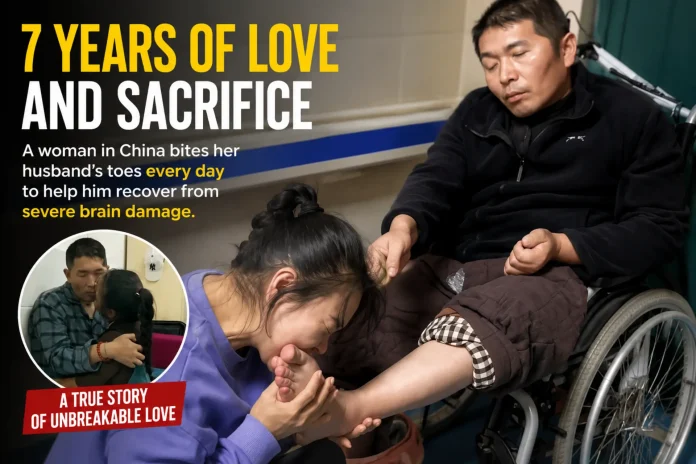
Song Mei in China’s Henan province spent nearly seven years biting her husband’s toes every day as part of efforts to reverse severe brain damage he suffered while saving a toddler from a fall. Last week her persistence produced a remarkable breakthrough when Zhao Jinqian spoke his first words in years, telling her simply that he loves her, in a story covered by the South China Morning Post and tracked across Asia this week.
The October 2019 accident took place when Zhao, a waterproofing worker on construction sites, climbed onto a warehouse roof to rescue a trapped three-year-old child. He shielded the child with his body during the roughly six-meter fall. The toddler escaped unharmed, but Zhao landed head-first and sustained catastrophic brain trauma and multiple fractures that left him in a vegetative state. Doctors initially gave him very limited chances of meaningful recovery.
Song Mei, then a 45-year-old kindergarten art teacher, immediately quit her job to become his full-time caregiver. Medical professionals recommended regular stimulation of his fingers and toes to support nerve recovery and help prevent sensory deprivation. This approach is a recognized component of care for patients with disorders of consciousness. Tactile input travels through peripheral nerves to the spinal cord, then to the thalamus and somatosensory cortex, where it can help activate arousal networks and support neuroplasticity.
After noticing a subtle response when she accidentally bit one of his toes, Song Mei turned the action into a daily routine. She covered his foot with a plastic food bag for hygiene and combined the intense tactile stimulation with years of massaging his limbs, talking to him, singing familiar songs, and assisting with physical exercises.
The couple had lived modestly with their two children and were known locally for small acts of generosity, including free painting lessons Song Mei gave to children from low-income families and support Zhao provided for a student from a remote area. Medical costs quickly depleted their savings, though the father of the rescued child helped raise additional funds for treatment.
Evidence for structured sensory stimulation programs in vegetative and unresponsive wakefulness states is mixed, according to peer-reviewed research on sensory stimulation for coma and vegetative state patients. Some studies report improved arousal and responsiveness, while others find results comparable to spontaneous recovery over time. Long-term emergence from such states after nearly seven years remains uncommon but has been documented in cases where some minimal brain function was preserved, a recovery space where Chinese scientists have separately reported reviving frozen human brain tissue. Song Mei has credited the consistent daily care, including the toe-biting routine, with helping maintain neural pathways during the long period of reduced consciousness.
Zhao began showing gradual improvement in 2024, opening his eyes more readily and responding more strongly to stimulation. The pivotal moment came on June 30, 2026, when he lay in a hospital bed and whispered his first words in years: “Song Mei, I love you,” as documented by Singapore outlet Mothership. He can now understand spoken language, raise his hand in response, and stand briefly with assistance. He has also begun simple writing practice, though he has so far only managed to form his wife’s name, a sustained-care pattern that echoes the long-haul hospital devotion seen when another Chinese man maintained a 12-hour daily commute to visit his hospitalized wife.
This story stands out because it shows how sustained, personal caregiving can intersect with established medical principles of sensory stimulation. While no single technique guarantees recovery, the combination of daily tactile input, emotional connection through talking and singing, and years of devoted full-time care appears to have played a meaningful role. Long-term emergence after such an extended period highlights both the resilience of the human brain and the extraordinary impact of one person’s refusal to give up.
Families facing similar challenges often find quiet encouragement in accounts that demonstrate how consistent effort over many years can lead to moments of connection that once seemed impossible, including decades-long love stories such as Denzel and Pauletta Washington’s 41 years of marriage. The rapid spread of the story across Chinese social platforms reflects a universal appreciation for quiet persistence and the power of love sustained through the most difficult circumstances.