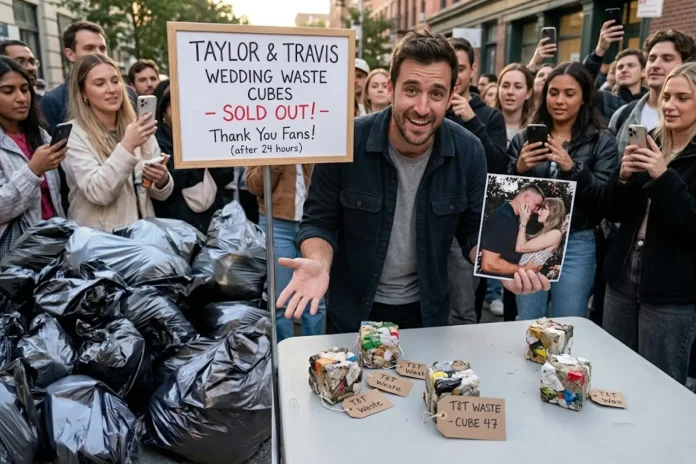
An enterprising New York artist turned ordinary street litter into a hot commodity on July 3, 2026, selling out an entire batch of small sealed plastic cubes filled with trash collected right outside Madison Square Garden on the very day Taylor Swift and Travis Kelce’s journey from Arrowhead to the aisle reached its headline moment. Each twenty-five-dollar cube was claimed by buyers within just twenty-four hours of going on sale.
The story is completely real. Justin Gignac, a New York–based conceptual artist who has built a two-decade career packaging everyday street litter into sealed collectible cubes through his New York City Garbage project, collected the materials himself on July 3, 2026, the Friday of the couple’s private wedding at the iconic arena. He showed up dressed in a full tuxedo, armed with a litter picker, and worked the streets and perimeter around the venue after the ceremony. The resulting cubes measure about one inch by one inch by three-quarters of an inch and contain a random mix of everyday discards from that day, including cigarette butts, bottle caps, plastic straws, utensils, pieces of a rainbow fan, a Ring Pop, a single left AirPod, and one discarded ovulation test kit. Several items were deliberately tied in knots to playfully nod to the wedding theme.
Gignac sealed each transparent cube so nothing would leak or smell, added a printed label that read “New York City Garbage” along with “JUST&T MARRIED! 7/3/26,” and signed every one at the bottom. His sales listing captured the spirit of the project with the line:
“There’s garbage on the floor after the party. Collected from the edge of a love story outside Madison Square Garden, as close to Taylor & Travis’ big day as you could’ve gotten without an invite.”
The small cubes sold for twenty-five dollars each plus ten dollars for shipping, while larger versions went for around one hundred dollars. He promoted the drop through short videos on TikTok and Instagram that quickly racked up hundreds of thousands of views, and the limited batch disappeared within a day.
More than thirteen hundred of these tiny cubes found new homes with buyers spread across more than thirty countries. Many of the purchasers appear to be devoted Swifties eager for any tangible connection to the high-profile wedding, treating the cubes as quirky souvenirs or conversation pieces that let them feel a small part of the “love story.” Others are collectors drawn to Gignac’s long-running conceptual work, which has always played with ideas of value, packaging, and what society chooses to keep or discard. Some buyers simply found the whole concept hilarious or thought-provoking and wanted a physical reminder of how celebrity culture can turn even literal trash into something desirable.
Gignac has been running this exact type of project for over two decades, creating limited-edition cubes tied to major New York moments such as parades and holidays. He has always framed the work as an exploration of how presentation can completely change how people perceive something ordinary. In this case, the proximity to one of the most talked-about weddings of the year gave the cubes an extra layer of cultural electricity. The wedding itself stayed highly secretive, with streets around the Garden closed and confirmation coming largely through those famous “JusT&T Married” billboards that confirmed what fans had been whispering about since the holiday buzz. Gignac never claimed the trash came from inside the venue or belonged to any specific guest; he simply gathered what was left on the surrounding streets that day, turning public space into private keepsakes.
What makes the rapid sell-out so striking is how it reveals the current appetite for anything that feels connected to big cultural events. In an era where fans often build deep emotional attachments to celebrities they will never meet, these cubes offered something physical and exclusive-feeling, even if the contents were completely mundane. Some buyers likely wanted them as lighthearted jokes or ironic art pieces, while others may have seen them as modern relics of a moment that dominated headlines and social feeds. Either way, the project succeeded in doing exactly what Gignac set out to do years ago: prove that thoughtful packaging and a compelling story can make people line up for something they would normally throw away.
The whole episode also quietly comments on the blurred line between art, commerce, and fandom. By dressing up in a tuxedo to collect the material and then pricing it accessibly, Gignac created both a product and a performance that poked at how much value society assigns to proximity with fame. Whether the cubes end up displayed on shelves as quirky conversation starters or tucked away as private mementos, they now carry their own small slice of the Swift-Kelce wedding narrative, one that started on the streets of New York and traveled around the world in clear plastic boxes.