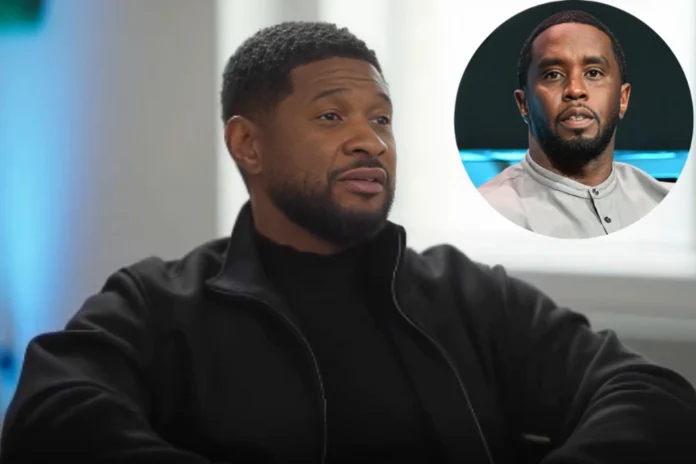
R&B superstar Usher has spoken warmly about his longtime mentor Sean “Diddy” Combs, describing the embattled music mogul with one word: “Legacy.”
In a recent episode of Forbes’ The Enterprise Zone series, hosted by senior writer Jabari Young, Usher participated in a word-association game with influential figures in his life. When Young mentioned “Sean Combs,” the singer immediately responded with “Legacy,” before elaborating on his perspective.
“I don’t have anything negative to say about Sean Combs because my experience was not what the world has seen and how he’s been, you know, misrepresented,” Usher said. “I’m not saying that every man is perfect. I’m not saying that all of us don’t have flaws, but I can’t with any sense of humanity not recognize the valuable contributions that this man made for us as Black entrepreneurs, for us as people who transition culture and ideas into something that’s tangible. So many people benefited from what he created. And I acknowledge that. That’s why I see him as legacy.”
Usher, 47, referred to Combs — whom he also called “Puff” — as a mentor who served as “a really, really hard teacher,” from whom he learned “in real time.” He noted that their relationship spans more than 30 years and emphasized focusing on the positive impact Combs has had on the industry.
The comments come after Combs, 56, was convicted in July 2025 on two counts of transportation to engage in prostitution. In October 2025, a federal judge sentenced him to 50 months in prison, along with a $500,000 fine and five years of supervised release. He is currently serving his sentence at FCI Fort Dix in New Jersey and is projected for release in April 2028. Combs was acquitted on the more serious charges of racketeering conspiracy and sex trafficking by force, fraud or coercion.
Usher’s remarks are rooted in his personal history with Combs. As a teenager in the early 1990s, the then-13-to-15-year-old Usher was sent by LaFace Records co-founder L.A. Reid to live with Combs in New York for roughly a year as part of an informal mentorship known as “Puffy Flavor Camp.” The arrangement was designed to immerse the young artist in the music business during the height of Bad Boy Records’ success.

In a 2016 interview on The Howard Stern Show, Usher described the experience as “pretty wild… crazy.” He recalled the household being filled with major artists including The Notorious B.I.G., Lil’ Kim, Faith Evans, Mary J. Blige and Craig Mack, who treated him like a “little brother.”
Usher also spoke of witnessing adult situations and parties, saying he encountered “very curious things” as a young teen that he didn’t fully understand at the time. He has consistently clarified, however, that it was not the extreme scenarios alleged in Combs’ legal cases, and when asked if he would send his own children to “Puffy camp,” he replied, “Hell no.”
Usher has never accused Combs of personal wrongdoing toward him and has credited the mentorship with helping shape his early career, including the release of his 1994 self-titled debut album.

Reactions to Usher’s Forbes comments have been mixed. While some online have expressed disappointment, viewing the remarks as downplaying Combs’ legal troubles, others have noted Usher’s right to speak from his own lived experience. Combs’ longtime rival 50 Cent trolled the comments indirectly on social media.
Usher’s stance highlights the complex intersections of personal loyalty, mentorship and public accountability in the music industry. He has made clear that he chooses to focus on Combs’ contributions as a pioneering Black entrepreneur and cultural figure — through Bad Boy Records and beyond — rather than the controversies surrounding him.