

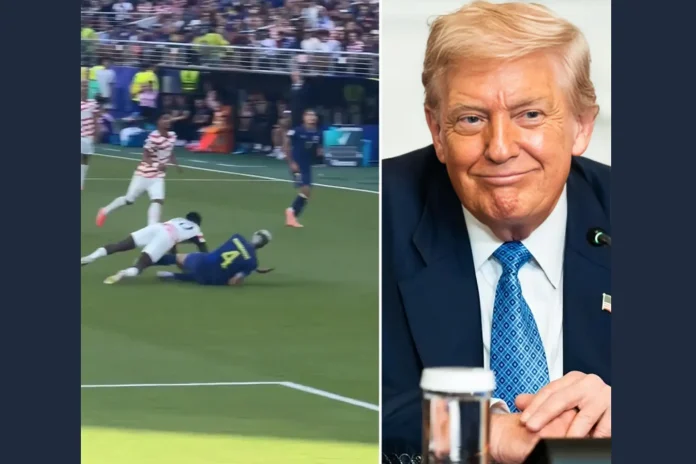
The president of the USA, Donald Trump, directly contacted Gianni Infantino, who heads FIFA, regarding the suspension of U.S. striker, Folarin Balogun, after he got a red card during the match against Bosnia and Herzegovina in the Round of 32 stage of the competition. The unprecedented situation has placed politics at the center of the 2026 FIFA World Cup.
During the game between the United States and Bosnia and Herzegovina that took place on Wednesday, July 2, 2026, Folarin Balogun, 25 years old, got a straight red card in the second half of the game. The episode happened after a 50/50 challenge where the striker’s leg hit Bosnian defender Tarik Muharemović on his ankle and calf area.
The on-field referee from Brazil initially allowed play to continue. VAR officials from Venezuela, Colombia, and France recommended a review, leading to the upgraded red card decision. Balogun’s availability for the United States’ next match appeared over under standard FIFA rules, which impose an automatic one-game suspension for a straight red.
The call divided observers. Many analysts and former players argued the tackle lacked malicious intent and appeared awkward rather than reckless, especially when viewed at full speed. Others maintained that the contact justified the dismissal under FIFA’s disciplinary standards.
Multiple credible outlets, including The New York Times, Reuters, and the Associated Press, reported that Trump contacted Infantino hours after the match to urge a review of the suspension. A second conversation reportedly followed the decision. Trump later posted on Truth Social:
“Thank you to FIFA for doing what was right and reversing a great injustice.”
On Sunday, July 5, FIFA’s disciplinary committee invoked Article 27 of its Disciplinary Code. The organization suspended Balogun’s one-match ban on a one-year probationary basis, making the Monaco forward eligible for the United States’ Round of 16 matchup against Belgium in Seattle on Monday. The red card remains on record, but the suspension is held in abeyance unless Balogun commits a similar offense during the probation period.
FIFA has not publicly stated that Trump’s call caused the ruling. The timing has fueled widespread discussion, but officials framed the move as an application of existing rules. Reports describe the reversal as highly unusual, with some noting it as the first comparable World Cup suspension lift since 1962.
The Royal Belgian Football Association expressed “astonishment” at the decision. Belgium coach Rudi Garcia publicly criticized the ruling, with some accounts comparing the optics to an April Fools’ joke. Football commentators, including Gary Neville and Ian Wright, called the process “shameful” and damaging to fair play.
Governance experts and rival officials have questioned whether political involvement could undermine confidence in FIFA’s independence. Balogun, a key performer with three goals in the tournament so far, gives the U.S. attack a significant boost against Belgium.
Trump and Infantino are known to have connections; the latter granted Trump the first-ever FIFA Peace Prize in 2025. Coach of the American team Mauricio Pochettino expressed his support for the decision stressing the necessity of following the rules of football.
This case sheds light on the issues of using VAR with slow-motion replay, refereeing standards, and politics in sport. While the core facts Trump’s reported call, the original red card, and FIFA’s probationary ruling are supported by consistent reporting from major outlets, no official evidence confirms the presidential intervention as the direct cause of the reversal. Readers are urged to distinguish verified events from speculation about causation.
This rare intervention arrives during a World Cup co-hosted by the United States and could test public trust in one of global sports’ biggest events. As the tournament advances, the focus remains on whether such decisions strengthen or strain the credibility of FIFA’s disciplinary processes.

