

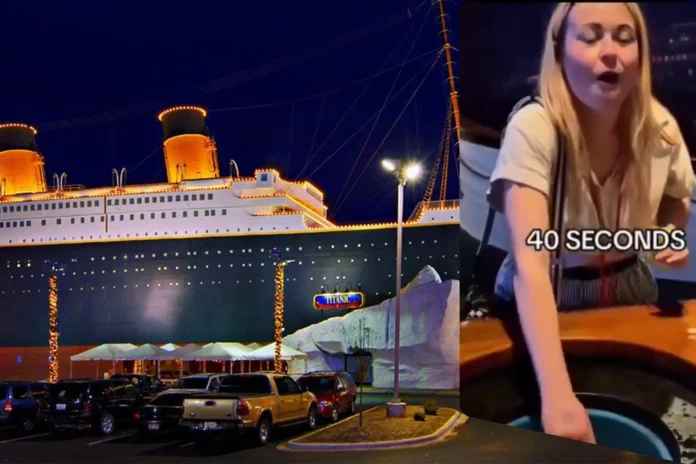
Imagine dipping your hand into water so cold it burns like fire within seconds—that is the unforgiving reality now confronting every visitor who steps up to the newest exhibit at the Titanic Museum Attraction in Branson, Missouri.
The “Cold Water Experience” plunges participants’ hands into a tank kept at exactly −2 °C (28 °F), the documented temperature of the North Atlantic at 2:20 a.m. on April 15, 1912, when the RMS Titanic vanished beneath the waves. What feels like a simple 30-second challenge instantly transforms abstract history into a visceral, skin-numbing lesson in survival.
Most adults yank their hands out in under 20 seconds, gasping as the icy grip shifts from stinging pain to complete numbness. Children often last even less time, wide-eyed and suddenly quiet. The museum deliberately times every attempt on a digital clock and posts the results on a wall leaderboard; the current record stands at two minutes and four seconds—an agonizing mark that still falls short of the 15 to 30 minutes many victims endured while clinging to debris or floating in collapsed lifeboats before hypothermia claimed them.
On that moonless night, the Titanic carried 2,224 passengers and crew from every walk of life: millionaires in first class, immigrants chasing new beginnings in steerage, and hundreds of workers who built and sailed the ship. When the “unsinkable” liner struck an iceberg and foundered just 375 miles south of Newfoundland, more than 1,500 people entered water so cold that screaming lasted only minutes and consciousness slipped away long before the heart stopped. The Carpathia, the nearest rescue ship, arrived nearly two hours later and pulled 706 stunned survivors from lifeboats—yet recovered almost no one still alive in the sea itself.
Scientific studies on cold-water immersion explain why this is the case. At −2 °C, the human body loses heat 25 times faster than in air of the same temperature. Grip strength collapses within 30 to 60 seconds, making it nearly impossible to grasp ropes or climb ladders. Medical journals confirm that even strong swimmers became helpless within ten minutes, their muscles seizing as their core temperature plummeted. The museum’s tank replicates these conditions with chilling accuracy, using refrigerated saltwater to match the ocean’s salinity and its ability to remain liquid below the normal freezing point of fresh water.
The Branson museum, shaped like the Titanic itself and situated in the Ozark Mountains, hundreds of miles from any ocean, houses one of the world’s most extensive permanent collections of authentic artifacts rescued from the wreck site, 12,500 feet below the surface. Visitors walk actual decks reconstructed to full scale, touch a real iceberg maintained at the same deadly temperature, and now, with this new exhibit, feel the ocean that swallowed a legend in less than three hours.
Staff members say the Cold Water Experience has profoundly changed how people leave the building. Teenagers who once rolled their eyes at “old history” now speak in hushed tones about the third-class mothers who passed babies up to strangers in lifeboats they themselves could not board. Couples emerge holding hands a little tighter, many admitting the brief sting made them think about every passenger who faced that night with no warning and no second chance.
For those ready to test their own limits against the same water that defeated the Titanic, tickets and visitor information are available at the official museum site. Anyone curious about the science behind the shock can explore cold-water survival facts at the National Center for Cold Water Safety.
More than a century later, the North Atlantic’s silent bite still teaches the hardest lesson of the Titanic disaster: grandeur and technology mean nothing when nature turns merciless. In Branson, thirty seconds is all it takes to understand why most of the 1,500 never had a fighting chance.
