In the shadow of Halloween fireworks, a single gunshot echoed through South Los Angeles, claiming the life of a young man caught in the unrelenting grip of street rivalries.
Jabari Henley, known to many as Baby Uiie, fell outside a smoke shop on 69th Street and Figueroa late on October 31, 2025.
The 25-year-old was leaving the store around midnight when unknown attackers opened fire in what police describe as a brazen ambush.
Paramedics rushed to the scene, but Henley succumbed to his wounds right there on the cracked sidewalk, his body covered by a white sheet as officers worked frantically to revive him.
Henley’s death strikes deep because of his family ties.
He was the son of Eugene Henley Jr., better known as Big U, a towering figure in the Rollin 60s Neighborhood Crips who spent decades navigating the treacherous world of South L.A. gangs before pivoting to music and community work.
Big U played a key role in launching careers, such as that of the late Nipsey Hussle, turning his street smarts into a bridge between hip-hop’s raw edges and its redemptive stories.
Yet even as he stepped back from the front lines, the past has a way of pulling people back in—Henley’s killing feels like a grim reminder of that pull.
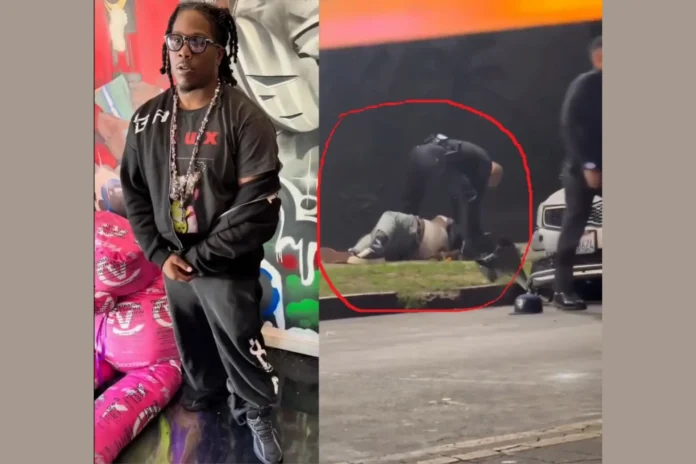
Eyewitness videos circulating online capture the chaos in stark detail: flashing police lights cut through the night, yellow tape seals off the shop’s door, and bystanders huddle on the sidelines, phones held high.
One clip shows an LAPD officer kneeling beside the shrouded figure, pressing down in desperate chest compressions.
The air hums with distant party music from Halloween block parties, a jarring contrast to the finality unfolding on the curbside. Graffiti on nearby walls—faded nods to old-school rap crews—frames the scene like a snapshot from a forgotten album cover.
The Los Angeles Police Department’s South Bureau Homicide Division leads the probe, treating this as a targeted hit amid simmering tensions in Hyde Park.
No suspects are in custody, and details on the shooters remain scarce, though whispers in the neighborhood point to old beefs flaring up.
For families like the Henleys, these losses compound quickly; Big U himself faces federal charges from earlier this year, accused of running a wide-ranging criminal network that tangled extortion with influence in entertainment circles.
Learn more about LAPD’s efforts to curb gang violence in South L.A.
What makes this story more than another statistic is the human thread running through it.
Baby Uiie grew up in a home where survival meant constant vigilance, yet he carved out his own path, far from the spotlight his father once commanded.
In a city where young Black men face odds stacked against them—homicide rates in South L.A. still hover far above national averages—this tragedy underscores a cycle that demands breaking.
“I’ve covered these streets for years, and each name etched into the pavement chips away at community fabric, leaving mothers to bury sons and brothers to chase ghosts of vengeance.”
Experts in gang intervention point to programs like Homeboy Industries, which offer tattoos-turned-jobs for those ready to leave the life behind, as beacons of hope.
Big U’s own shift to promoting artists showed that change is possible. Still, Henley’s death raises challenging questions: How do we protect the next generation when retaliation lurks around every corner?
Authorities urge anyone with tips to come forward anonymously through Crime Stoppers, emphasizing that silence only deepens the wounds.
As dawn broke over Figueroa on November 1, friends gathered near the site, lighting candles and murmuring prayers under the morning haze.
Jabari Henley deserved more than a sidewalk eulogy.
His story, woven into the larger tapestry of L.A.’s resilience and regret, calls on all of us to push for the peace he never fully knew.
Rest in power, Uiie.