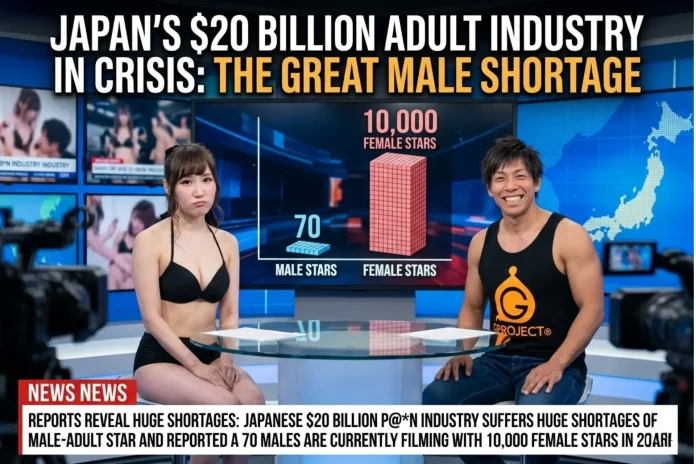
Japan’s adult video industry, valued at around 20 billion dollars, continues to operate with only about 70 active male performers supporting an estimated 10,000 female performers.
This imbalance, first highlighted more than a decade ago by veteran actor Ken Shimizu, known professionally as Shimiken, places intense pressure on a small group of men to meet the demands of thousands of monthly productions. The situation has resurfaced in online discussions in 2026, prompting fresh attention to the structural challenges within one of the world’s largest adult entertainment markets.
Shimiken, who has appeared in thousands of scenes since the late 1990s, drew public notice in 2014 when he described male performers as rarer than Bengal tigers. He noted that roughly 4,000 new titles emerge each month, yet the pool of reliable male talent remains limited. Many men hesitate to enter the field because of the physical stamina required, the need for full time availability, and the long term impact of social stigma on future career prospects. Female performers, by contrast, enter in far greater numbers, often debuting at a rate of several thousand per year, which sustains high output but strains the supporting roles.
The shortage affects production schedules and performer well being. Experienced male actors frequently handle multiple scenes in a single day or week, leading to burnout risks that industry insiders have acknowledged for years. Some estimates from the period when Shimiken first spoke out suggested the active core of male talent could be even smaller than 70, closer to 30 in regular rotation. No comprehensive official census exists for the sector, which operates largely through private studios and distributors, but the persistent recirculation of these figures indicates that recruitment has not kept pace with demand.
Observers point to cultural and practical barriers as key reasons for the gap. Strict anonymity expectations, combined with the demanding nature of on camera performance, deter many potential candidates. At the same time, the industry’s professional standards in Japan emphasize polished productions that rely on consistent male leads for narrative flow in many titles. This dynamic creates a cycle in which a handful of established names shoulder most of the work, limiting opportunities for newcomers and potentially affecting diversity in content over time.
The viral attention in early 2026 underscores how labor realities in specialized sectors can capture public imagination. While the numbers originate from Shimiken’s own observations rather than audited data, their endurance highlights genuine supply constraints in a high volume industry. For those considering entry, the role demands more than physical capability; it requires navigating privacy concerns and professional boundaries in a field where personal lives often remain shielded from public view.
Broader market context shows Japan’s adult entertainment segment contributing significantly to regional revenue streams, though exact breakdowns vary across reports. The imbalance serves as a reminder that even lucrative creative industries face human resource limitations that technology or outsourcing cannot fully resolve. As discussions continue online, the story invites reflection on working conditions for performers across genders and the importance of sustainable practices in any high output sector.
For further context on performer experiences, see Shimiken’s long career documented through industry profiles. Details on global adult market trends appear in analyses from research firms tracking entertainment sectors. Readers interested in labor dynamics in Japan’s entertainment fields may consult public discussions on performer rights and industry standards. Additional background on the Japanese AV market can be found through major industry distributors.