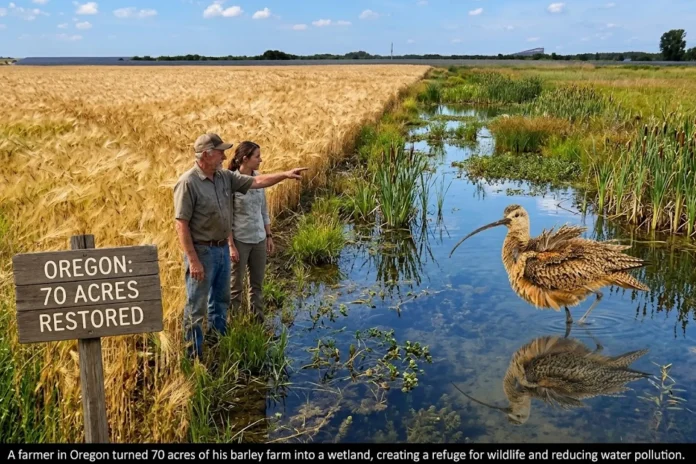
[KLAMATH FALLS, Ore.] — A viral post this week from the celebrity-news account @pubity has resurfaced a year-old Oregon story that conservation researchers say quietly became one of the most watched wetland-restoration experiments in the American West: a retired orthopedic surgeon who bulldozed 70 acres of his barley operation into a managed wetland that now hosts more than 140 bird species, tens of thousands of waterfowl, and a self-sustaining nursery for two federally endangered fish found nowhere else on Earth.
Karl Wenner, a co-owner of the roughly 400-acre Lakeside Farms on the southeastern shore of Upper Klamath Lake near Klamath Falls, Oregon, executed the conversion in 2021 with help from the U.S. Fish and Wildlife Service, the Klamath Tribes, the Natural Resources Conservation Service, and a handful of local conservation groups. The move was framed not as a giveaway of farmland but as a fix for a problem Wenner said he had ignored for too long: phosphorus leaving the property at roughly five times Oregon’s regulatory limit, water-quality data he learned about only after buying into the farm in 2017, according to The Guardian’s October 2023 profile.
“This place wanted to be a wetland,” Wenner told The Guardian, describing how crews flattened the uneven former barley fields, then shaped shallow water zones, channels, dikes and small islands so water from the farm and from natural seeps could move slowly through the site. The new wetland began filtering phosphorus effectively within about 18 months to two years, allowing cleaner water to reach Upper Klamath Lake — a body of water that, according to the Klamath Tribes’ own newsroom, is now “poisonous” to native fish during much of the summer because of accumulated nutrient loading.
Wildlife arrived almost immediately. Counts recorded by the U.S. Fish and Wildlife Service logged more than 20,000 ducks on the property in early autumn months after the flooding began, with later surveys documenting tens of thousands of ducks, geese and swans using the area in a single season, alongside otters, beavers, muskrats and other mammals. At least 140 bird species have been documented on the farm overall, a number that researchers told Yale Environment 360 in a June 2025 feature places Lakeside Farms among the most biodiverse private-land sites in the upper Klamath Basin.
The wetland’s second, less-publicized function is the one that drew the Klamath Tribes into the project. Upper Klamath Lake is the only place on Earth where two species of sucker fish — known as C’waam (Lost River sucker, Deltistes luxatus) and Koptu (shortnose sucker, Chasmistes brevirostris) — still exist in the wild. Both are federally listed as endangered and are central to the diet, ceremony and subsistence of the Klamath Tribes, whose elected council declared an emergency for the species’ restoration in September 2024, citing irreparable harm to Tribal culture. Beginning around 2022, USFWS and Tribal biologists began stocking thousands of juvenile C’waam and Koptu into the Lakeside ponds and channels to see whether private farmland could function as a refuge from a lake that, for many juvenile fish, is no longer survivable.
In May 2025, researchers with the U.S. Fish and Wildlife Service and the Klamath Tribes partially drained the wetland to check survival. They recovered roughly 50 adult-sized suckers — including some measuring up to 16 inches long — and noted that several appeared healthier and better-conditioned than many hatchery-raised fish of comparable age. The Herald and News of Klamath Falls reported the results in June 2025, framing them as the first strong signal that privately managed wetland habitat could meaningfully contribute to species recovery in a basin where juvenile survival in the lake itself has been poor for decades.
What makes Lakeside Farms unusual among wetland-restoration projects is not the acreage but the rotation. Wenner and his partners still grow barley on most of the property, and they do not treat the wetland as permanent set-aside. Instead, individual fields cycle in and out of wetland duty in what the Herald and News calls a “walking wetlands” model, and what the Natural Resources Conservation Service formally classifies as part of its Klamath Basin Farming and Wetland Collaborative Regional Conservation Partnership Program. A field submerged for one to four years returns to barley production with fewer weeds, fewer pests, improved soil structure and lower input costs; in some cases the resulting crop can qualify as organic. The wetland is, in effect, a rotation partner rather than a sacrifice zone.
Wenner has been compensated for taking 70 of his 400 acres out of production through an NRCS-administered program, Oregon Public Broadcasting reported in May 2022, and Wenner has said publicly that the revenue helped make the conversion financially viable. Other nearby landowners have since asked about similar projects, according to reporting by both The Guardian and Yale Environment 360, though NRCS staff caution that the walking-wetlands economics depend on site-specific water rights, soil type and the willingness of a Tribe or agency partner to co-manage fish-stocking activities.
The farm sits beside the remnant Hanks Marsh, a fragment of a much larger wetland fringe that once wrapped Upper Klamath Lake before early-20th-century diking and drainage opened tens of thousands of acres to farming. The Klamath Basin today retains fewer than 75,000 acres of the wetland base it had a century ago, a loss that researchers at the U.S. Geological Survey and the Klamath Tribes have linked directly to the collapse of juvenile habitat for C’waam and Koptu. Wenner’s project does not reverse that history, but Yale Environment 360 reported that it demonstrates one practical way private farmland can absorb phosphorus, host endangered native fish and keep producing a commercial crop in the same growing season — a model that, if scaled, would address the basin’s two biggest pressures on a single piece of ground.
The basin-scale context remains difficult. The Klamath Tribes are currently in active dispute over a federal water-allocation plan that Tribal leaders say will further degrade C’waam and Koptu habitat, and adult populations of both species in the lake are dominated by fish old enough to have been born in the 1990s — a demographic cliff the Klamath Tribes News has described as a race against time. Lakeside Farms offers one answer at one site. Whether that answer scales across the rest of the basin depends on whether NRCS funding, Tribal co-stewardship and willing landowners can be lined up at the same time, on enough ground, before the next generation of C’waam and Koptu runs out of juvenile habitat to grow into.