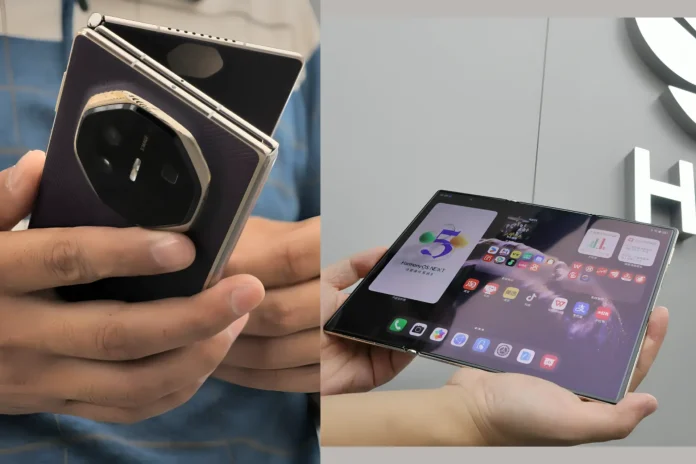
After having launched its second tri-fold smartphone, the Mate XT 2, Huawei made waves for reasons beyond the foldable screen. The company revealed that this new smartphone is powered by a 100 percent locally made Kirin 9050 Pro processor in the face of US sanctions ahead of Apple’s major September launch.
Huawei announced the phone on September 7, 2026, at Guangzhou. The phone will begin to be sold on September 12, 2026, in China alone. This smartphone starts at 19,999 yuan, or $2,980.
The Mate XT 2 uses an inward-folding “G-shaped” hinge. Closed, it looks like a regular phone with a 6.5-inch outer screen. Fully open, it becomes a 10.2-inch tablet-sized display. Huawei added a hardware Privacy Display that narrows the viewing angle so people nearby can’t easily read the screen. It also carries improved water and dust resistance (IP58/IP59 ratings), a 5,600 mAh battery, and runs HarmonyOS 7.
The camera configuration features a 50MP primary sensor with variable aperture, along with an ultra-wide and a periscope telephoto lens. The phone has a weight of about 299g.
As far as Huawei is concerned, the Kirin 9050 Pro is a more important landmark. According to Huawei, the processor utilizes the LogicFolding architecture based on the Tau Scaling Law. In other words, Huawei is saying that logic elements are stacked in layers, and the small manufacturing technologies are not used anymore.
Huawei states the chip delivers more than 40 percent better overall performance than the previous generation, with specific gains of about 24 percent in single-core and 52 percent in multi-core scores. These remain company claims. Independent benchmarks have not yet confirmed the numbers.
Nikkei Asia and other outlets reported Huawei’s description of the chip as free from U.S. supply restrictions. That phrasing needs careful handling. Huawei designed the core architecture itself after years of U.S. export controls that cut the company off from advanced chips and tools. Designing its own silicon is different from proving every material, tool, or step in the full manufacturing supply chain contains zero U.S.-origin technology. Reuters confirmed the launch, pricing, and the LogicFolding claim but did not independently audit the entire supply chain.
While the phone itself is real, a separate controversy erupted around its promotion. Tech creators GregsGadgets, Marques Brownlee (MKBHD), and JerryRigEverything publicly confirmed receiving similar campaign briefs. The messages offered paid collaborations, asked creators to remix Huawei-provided footage for TikTok, and instructed them not to label the content “paid” or “sponsored.”
GregsGadgets shared the brief and warned that hiding paid relationships violates FTC guidelines and disrespects viewers. MKBHD replied that he received the same email and called it “fully insane.” The creators noted the outreach appeared to come through a third-party agency rather than Huawei corporate directly.
Huawei’s official account responded quickly on X:
“HUAWEI is aware of recent reports regarding an unauthorized influencer campaign email circulating online. We want to unequivocally clarify that HUAWEI has neither issued nor authorized any third party to conduct this outreach. We are looking into the possible source of the brief content in question. HUAWEI is committed to transparent disclosure in all public communications and is strengthening its oversight to ensure all marketing activities meet platform policies and industry standards.”
American consumers cannot buy the Mate XT 2 because of long-standing U.S. sanctions that also block Google services. Still, the launch lands as a direct challenge in the global foldable race. Huawei already dominates China’s foldable market. Samsung has tried its own tri-fold experiments. Apple is widely expected to enter the category soon. The phone and the chip claims show how far Huawei has pushed its domestic technology under pressure. The marketing mess, meanwhile, raises fresh questions about transparency in influencer campaigns timed around major U.S. product events.