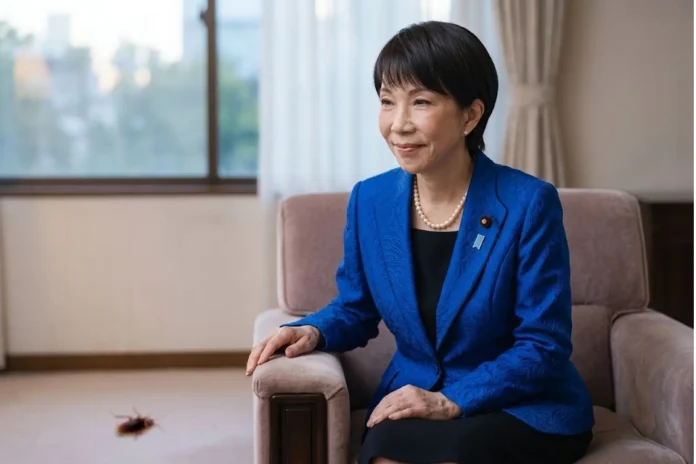
Sanae Takaichi, Japan’s first female prime minister, spent most of a Saturday in August answering questions about the brick mansion next to her office in Tokyo. Has she seen the ghosts? No. Has she seen a cockroach? Yes. And the answer to that second question has now become one of the more unusual footnotes of her young administration.
Takaichi wrote on X on August 22, 2026, in a series of posts originally in Japanese, that she had never encountered a ghost in the official residence but had, until recently, been the one screaming when she came across cockroaches. After moving in, she wiped the floor under the dining table, put food scraps in a sturdy lidded garbage can, and washed and sorted plastic containers. A cockroach still scurried past her feet one day. The sight, she wrote, shocked her.
She could not bring herself to kill it. As a child, Takaichi explained, she fell hard for Osamu Tezuka’s manga “Phoenix” (火の鳥, Hi no Tori; also rendered in English as “Firebird”), a series built around reincarnation and the idea that life keeps changing form. The series, left unfinished when Tezuka died in 1989, is one of the most philosophically ambitious works in the medium. Takaichi said the theme stayed with her.
“Maybe because of that, even now as an adult, I can’t bring myself to kill insects, cockroaches included,”
she wrote. Looking at the one in her residence, she thought it too might be part of that long cycle. She waited, hoping it would leave on its own.
When she finally told her secretaries, they were appalled.
“It’s unclean. I’ll handle it,”
one said firmly, and arranged for what Takaichi called Operation Combat. After that, the cockroaches stopped appearing.
“I felt relieved, but also a little lonely, or maybe sad,”
she wrote. The phrase, picked up by Japanese and international outlets, became the headline the next morning.
In a separate post the same day, Takaichi explained why she spends so much time at the residence in the first place. She treats it as a workplace. Meetings and document review happen there at odd hours. Staying put reduces the burden on the security officers and special police who would otherwise accompany her on every outing.
“I have made it a point to actively utilise the prime minister’s residence,”
she wrote,
“which allows me to minimise the number of staff and security personnel, including special police, who need to be involved.”
The residence dates to March 18, 1929. It was the site of the May 15 Incident of 1932, in which Prime Minister Inukai Tsuyoshi was assassinated by young naval officers, and the February 26 Incident of 1936, when renegade soldiers attacked the building in an attempt to kill Prime Minister Keisuke Okada. Six people died, including Okada’s brother-in-law. One bullet hole from the 1936 attack was preserved. The incidents gave rise to rumors that the residence is haunted. The wife of Prime Minister Tsutomu Hata wrote in a 1996 memoir that she saw spirits in old military uniforms in the garden. Takaichi, asked about the ghosts, said simply that she had never met any.
Takaichi, born March 7, 1961, in Yamatokōriyama, Nara Prefecture, became Japan’s first female prime minister on October 21, 2025, after winning the Liberal Democratic Party leadership contest. Her father, Daikyū Takaichi, worked for an automotive firm affiliated with Toyota. Her mother, Kazuko Takaichi, who died in 2018, served in the Nara Prefectural Police. Her parents refused to pay tuition if she left home for a private university in Tokyo, so she commuted six hours a day to Kobe University, paying her way with part-time work. She graduated in 1984 with a bachelor’s degree in business administration, then enrolled at the Matsushita Institute of Government and Management. In 1987 she moved to the United States as a congressional fellow for Democratic Rep. Patricia Schroeder. She was first elected to the House of Representatives in 1993.
She has held multiple cabinet posts under Shinzo Abe and Fumio Kishida, including internal affairs and economic security, and is known for a punishing work schedule. After winning the LDP presidency she pledged to “work, work, work, work and work.” In July she posted on X that zero to three hours of sleep had become the norm since taking office. Her husband, a former politician who suffered a stroke in February 2025, does the cooking.
The cockroach story spread quickly through Japanese and international media. Many readers found the contrast striking: the country’s first female prime minister, known for a punishing schedule and conservative views, admitting a soft spot for an insect she could not bring herself to harm. The cockroach anecdote may be the more candid post of her early premiership. The secretaries, focused on hygiene, took a more practical view. Their boss ended up both relieved and a little wistful.
The episode also landed in a tougher political moment. Takaichi has pushed measures to maintain Japan’s male-only imperial line of succession while delaying policies that would soften rising prices. A public opinion poll last month put her support at 41 percent, down 10 percentage points and below 50 percent for the first time since her sweeping general election victory in February. The Nikkei newspaper reported that she has spent more than half of her weekends and public holidays at the residence since becoming prime minister. Bloomberg found she has held the fewest cabinet meetings of any Japanese prime minister since 2012. The cockroach story, by contrast, read as a small act of disclosure from a leader whose daily rhythms have come under fresh scrutiny.