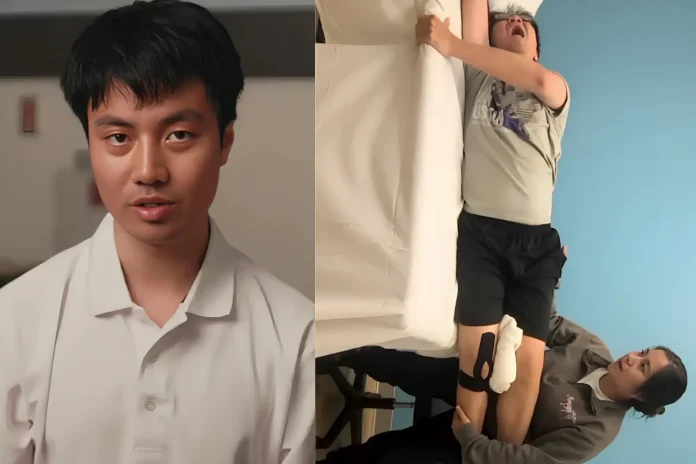
A Texas ultramarathon runner stood 5’6″ and felt it every day. His 5’2″ dad knew exactly how that felt. So the father opened his wallet for an estimated $150,000 leg-lengthening surgery that took his son to 5’9″.
In May 2025, Aaron Trinh, who was approximately 25 years old at the time and working toward an engineering degree in Houston, underwent the procedure at the Paley Orthopedic & Spine Institute in West Palm Beach, Florida. The procedure involved breaking his thighbones and implanting magnetic rods inside the body. These bones were then elongated at the rate of around 1 millimeter per day using an external apparatus for a period of up to four months.
Trinh told PEOPLE in an exclusive published October 8, 2026, that he constantly measured himself against others.
“Seeing how many people around me were much taller than I was, I realized I’m kind of different.”
He called the feeling height dysphoria and said it crowded out everything else. After spotting the procedure on TikTok, he researched it and went straight to his father.
“My dad was easily the first and probably the only person I would come to regarding the surgery, because I know that he would relate to me the most,”
Trinh said.
“He was the only one who was capable of supporting me throughout this process. He has suffered through height discrimination all his life, starting with his own family to people that were supposed to be his friends, even at the workplace.”
His father, who asked PEOPLE to remain anonymous but was identified as Tan Trinh in earlier reporting, described lifelong rejection.
“Because of my height. I just feel bad. I feel humiliated,”
He said.
“Can you imagine when you speak to people, you have to look up to them? And when they talk to you, they have to look down and you feel like you’re being talked down to all the time.”
He had pushed milk on his growing son and said he would have done the surgery himself if the technology had existed earlier. The pair kept the plan from Aaron’s mother until the day before the operation.
Recovery was hellish. Trinh considered the surgical day easy in comparison. Nerve pain was the toughest part, sometimes causing him to cry out, although he found it tolerable. He used crutches for months, learned to walk again, tracked all his symptoms, and kept studying from home. It was about eight months into his recovery that he realized that everything seemed farther away.
“Everything was shrinking,”
He said. In early 2026, he hiked a 22-mile trail.
Now 5’9″, Trinh reports the dysphoria is gone.
“Now that my height dysphoria is gone, I can mentally focus on a lot of other things” like graduation, career, and social life. “I am absolutely much more at peace with my mind and my body.”
He frames the choice as self-improvement, not vanity:
“It’s no different from wanting to work hard to improve yourself just as much as if you were wanting to go to the gym.”
The findings of the Paley Institute corroborated this case. In February 2026, an estimate from PEOPLE had pegged the expense at around $140,000; the October study had quoted a figure of $150,000 that covered the whole process. To date, no fact-checking organization has published a specific debunking of these claims that seem to be consistent with the reports by PEOPLE, New York Times, and the clinic.
The procedure poses some risks of nerve damage, infections, joint stiffness, slower bone healing, and additional surgeries. The critics contend that the practice represents an expensive and nonreversible attempt to medicalize natural variations of height in response to social pressure. However, supporters, including Trinh, hold that each individual is free to choose what will help him or her to perform well.
A story of silent fatherly support and arduous recovery of the son provided the human side of the practice. The question of height remains important for some people. This particular family spent three inches and endured pain to stop looking up.