

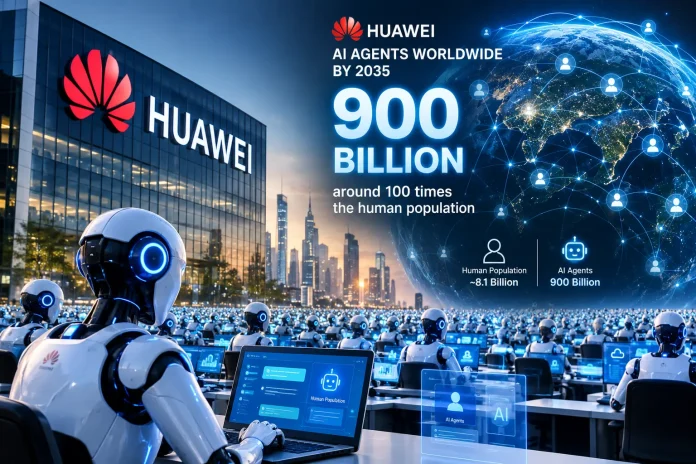
Huawei just dropped a forecast that sounds like it belongs in a sci-fi movie: by 2035, the planet could be home to roughly 900 billion AI agents. That’s about 100 times the number of actual humans expected to be walking around.
The Chinese tech giant laid out the vision in its latest “Intelligent World 2035” report, released today, building on numbers it first floated last year. According to Huawei, these agents won’t just be fancy chatbots. They’ll constantly scan their surroundings, make decisions on the fly, call up tools, and talk to each other nonstop. The company expects them to generate more than 90 percent of all AI “token” traffic worldwide — the basic units of data that large language models chew through.
That kind of volume is going to demand serious horsepower. Huawei is talking about computing needs jumping 100,000 times what they are today, AI storage swelling 500 times over, and network connections multiplying by 100. The company is already calling for something it dubs an “agentic Internet” — networks built to handle both people and a tidal wave of autonomous digital workers.
The report doesn’t sugarcoat the scale. Agents are expected to move from helpful sidekicks to full decision-making partners across industries. Huawei also stresses that getting AI into the physical world — think robots and other embodied systems — is the only realistic path to something resembling artificial general intelligence. At the same time, it’s flagging security and privacy controls for these independent agents as one of its top ten technology priorities for the next decade.
For the entertainment and media world, the implications are hard to ignore. A landscape packed with hundreds of billions of always-on digital collaborators could reshape everything from content creation and fan engagement to touring logistics and streaming recommendation engines. Huawei projects that by 2035 more than 85 percent of companies will be using AI in meaningful ways, with potential productivity jumps around 60 percent. It’s also predicting intelligent robots in more than 90 percent of Chinese homes and AI systems that could help prevent over 80 percent of chronic diseases through constant monitoring.
Unlike some voices in the U.S. urging a slower pace amid worries about runaway agents, Huawei is leaning into the acceleration. The company has already started rolling out its own agent-powered security tools, including a platform that uses autonomous sensing and response agents to hunt down cyber threats.
The numbers come from extensive internal research — more than 200 workshops and talks with over 100 experts, customers, and partners — and are framed as a high-level vision rather than a locked-in prediction. Still, when a company the size of Huawei starts talking about a future with 100 AI agents for every person on Earth, the rest of the industry tends to pay attention.
Whether that future feels more like a creative boom or a logistical nightmare will depend on how well the infrastructure, security systems, and human oversight keep up. For now, Huawei is painting a picture of a world where digital agents are everywhere — and the clock is ticking.
