

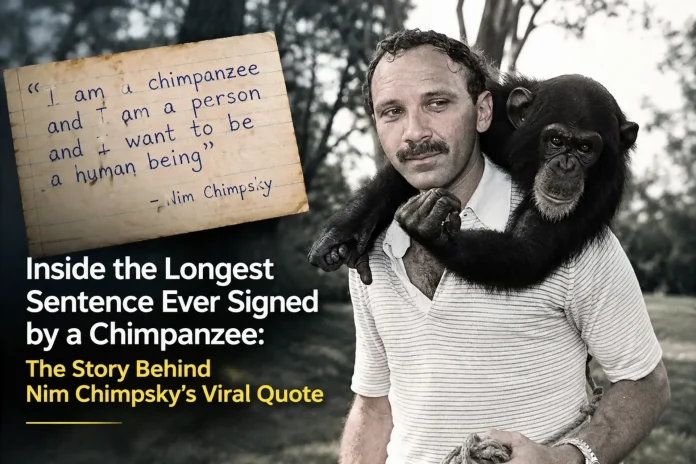
A chimpanzee named Nim Chimpsky once signed the longest recorded sequence any ape has produced: “Give orange me give eat orange me eat orange give me eat orange give me you.” The 16-sign string, captured in the mid-1970s during a Columbia University experiment, has resurfaced on X and TikTok this week as an absurd viral quote. Complex posted it Monday morning and replies quickly turned it into a joke about focus, Congress, and group-chat energy. The line is real. The story around it is messier than the meme.
Nim was born November 19, 1973, at the Institute for Primate Studies in Norman, Oklahoma. Psychologist Herbert Terrace, a Columbia professor and behaviorist influenced by B.F. Skinner, named him as a deliberate jab at linguist Noam Chomsky. Chomsky argued that the capacity for language is innate and uniquely human. Terrace wanted to test whether a chimp raised in a human environment and taught American Sign Language could form actual sentences and prove otherwise. Days after birth, Nim was taken from his sedated mother and flown to New York.
Stephanie LaFarge, a former student of Terrace’s, took the infant into her Upper West Side brownstone. She had seven children between her own and her husband’s. The household was loose and unconventional. LaFarge breastfed Nim even though she had no milk, and the kids treated him as a sibling. Formal signing was secondary to play and bonding. None of them were fluent in ASL. After roughly two years, Nim moved to a large house in Riverdale undergraduate student Laura-Ann Petitto. The switch was rough. He refused to be alone, ripped off clothes, and bit more often. Terrace had been involved with both women at different points. When the relationship with Petitto ended, she left, along with other core staff. About 60 caregivers rotated through the project. Most were students or volunteers who signed poorly.
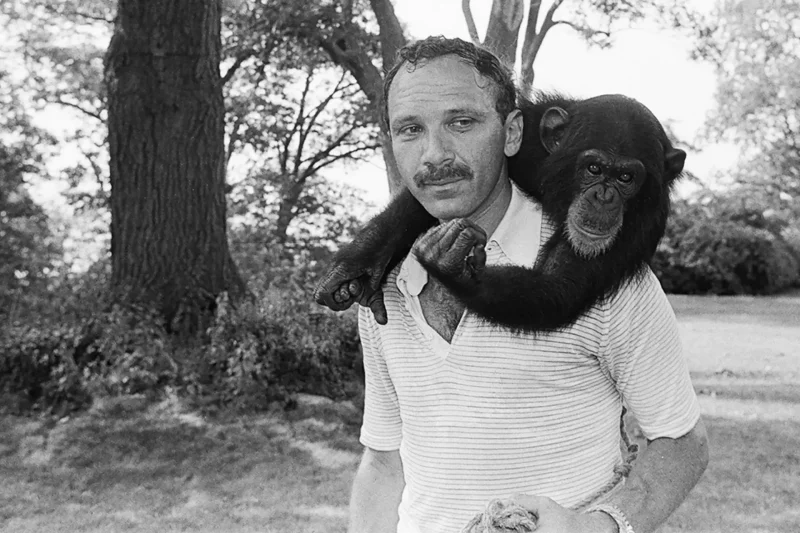
Nim learned roughly 125 signs by the criteria Terrace set: three independent observers seeing spontaneous use, plus appearance on five consecutive days. Edibles dominated early on—banana, apple, grape, orange, yogurt. Actions followed: eat, drink, play, tickle, hug, open. He also signed me, you, Nim, and names of people around him. Short combinations piled up: “play me,” “tickle me,” “eat Nim,” “more eat,” “give me eat.” Teachers logged nearly 20,000 multi-sign utterances. The mean length stayed flat around 1.1 to 1.6 signs, unlike the steady growth seen in human children. The longest stretch was the orange request. It loops the same handful of signs without adding new information or clear structure. Terrace later called combinations like it “wild cards”—me, more, Nim, hug—used because they reliably got a reward.
While the project ran, Terrace thought the position preferences in two-sign strings looked promising. After funding thinned and Nim grew too strong and aggressive to manage easily, Terrace ended it in 1977 and sent the chimp back to Oklahoma. Reviewing classroom videotapes in slow motion changed his view. Most of Nim’s signs were prompted by the teacher’s hands a fraction of a second earlier. Nim interrupted constantly and almost never started a conversation on his own. Longer strings did not expand shorter ones the way a child’s do. In the 1979 Science paper “Can an Ape Create a Sentence?”, Terrace, Petitto, and colleagues concluded that the behavior was better explained by imitation and reinforcement than by grammar. He extended the skepticism to brief clips of other signing apes. The paper drew sharp pushback from some trainers, who said informal settings showed more spontaneous use and that the classroom setup itself was stressful and poorly controlled.
Back in Oklahoma, Nim met other chimps for the first time as an adult. He adjusted, kept signing, and formed a bond with student Bob Ingersoll, who took him on long walks. When the institute began selling chimps to a biomedical lab in the early 1980s, Ingersoll and others mounted a public campaign. Media coverage and legal pressure got Nim and one companion pulled back. In 1983 philanthropist Cleveland Amory moved him to Black Beauty Ranch in Texas. Alone at first, he grew depressed, escaped sometimes, and once killed the ranch’s pet poodle. A companion named Sally arrived later. Nim taught her a few signs and stayed with her until she died. Additional companions arrived near the end. He died of a heart attack on March 10, 2000, at 26.
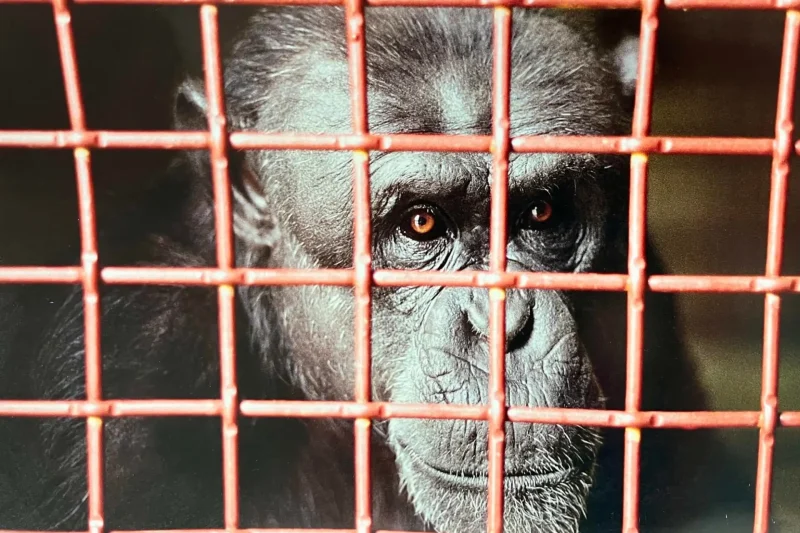
Elizabeth Hess’s 2008 biography and James Marsh’s 2011 documentary Project Nim filled in the human and ethical side: the separations, the staff chaos, the aggression, and the long stretches of isolation after the science ended. The orange sentence itself stayed mostly a footnote until a 2017 NPR Skunk Bear video used it. Edits that looped the phrase took off in 2020.
This week’s Complex post simply revived the cycle. The quote works as a meme because the desperation is obvious and the grammar is not. What the research actually showed is narrower: a chimp can learn dozens of signs and string them for food or play, but the data did not support open-ended, creative sentences of the kind human children produce. The rest of Nim’s life makes clear what the experiment cost him.

