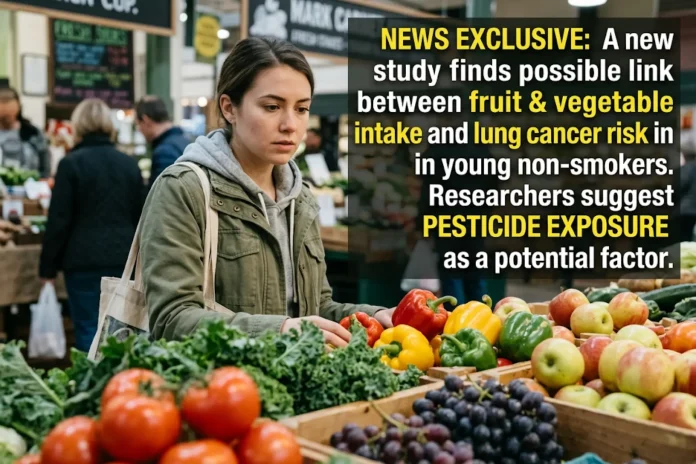
A new study has found that young non-smokers diagnosed with lung cancer reported significantly healthier diets, with higher intake of fruits, vegetables and whole grains than the average American. This raises questions about possible environmental risks such as pesticide residues on produce.
Researchers from the USC Norris Comprehensive Cancer Center at Keck Medicine of USC analyzed dietary data from 187 patients diagnosed with lung cancer before age 50. Most participants were women and had never smoked. The team used the Healthy Eating Index, which scores diet quality on a scale of 1 to 100. Patients in the study averaged a score of 65, compared with the national average of 57 drawn from U.S. population surveys. They consumed more total vegetables, dark green vegetables and legumes, whole fruits and whole grains than typical Americans.
The analysis drew from the ongoing Epidemiology of Young Lung Cancer study. Investigators grouped cases by tumor mutations, including EGFR pathway alterations and fusion-positive types common in never-smokers. Across these groups, diet quality remained elevated, with women scoring slightly higher than men. Researchers noted that categories with higher consumption often carry greater potential for pesticide or herbicide residues based on existing literature about commercial produce. No direct measurements of pesticides in patients or their food occurred in this work. The findings appeared as an abstract presented at the American Association for Cancer Research (AACR) annual meeting.
“Our research shows that younger non-smokers who eat a higher quantity of healthy foods than the general population are more likely to develop lung cancer. These counter-intuitive findings raise important questions about an unknown environmental risk factor for lung cancer related to otherwise beneficial food that needs to be addressed.”
Lead investigator Jorge Nieva, MD, a medical oncologist and lung cancer specialist at USC Norris, made the statement. Nieva and colleagues pointed to reports of elevated lung cancer among agricultural workers exposed to pesticides as a possible parallel worth exploring further. The full details are available in the official Keck Medicine of USC press release.
This small observational study does not prove causation and carries important limitations. Self-reported dietary recall can include biases, and the sample size remains modest. Broader evidence has long associated higher fruit and vegetable intake with reduced lung cancer risk in many populations, especially among smokers. Experts outside the research team have urged caution, emphasizing that the results remain preliminary and conference-based rather than fully peer-reviewed. No one should reduce consumption of these nutrient-rich foods based on this alone.
The rise in lung cancer among young never-smokers has puzzled clinicians for years. Traditional risk factors such as smoking fail to explain many of these cases. This work adds to efforts identifying modifiable environmental contributors beyond tobacco. Future research could include biomarker testing for pesticide metabolites in patients, comparisons across geographic regions with varying agricultural practices, and larger controlled studies. Public health guidance continues to support balanced diets rich in produce while calling for more data on food safety standards and residue limits.
For now, the message remains measured. Individuals concerned about lung cancer risk, particularly younger non-smokers, may benefit from discussing overall environmental exposures with their physicians. Resources such as the Epidemiology of Young Lung Cancer study on ClinicalTrials.gov offer details on the broader project. The AACR abstract database provides the original presentation materials. Those interested in dietary guidelines can review the USDA Healthy Eating Index documentation for context on scoring methods.
This investigation highlights how even well-intentioned healthy behaviors can intersect with modern agricultural realities in unexpected ways. It underscores the need for ongoing scrutiny of food production practices without undermining the proven benefits of nutrient-dense eating. As scientists pursue clearer answers, the priority stays on prevention through evidence-based means and continued support for patients facing early-onset disease.
Note: This is a preliminary conference presentation. The full study has not yet undergone peer review. Always consult a healthcare professional before making dietary changes. Hypefresh encourages readers to prioritize evidence-based nutrition and ongoing scientific research.