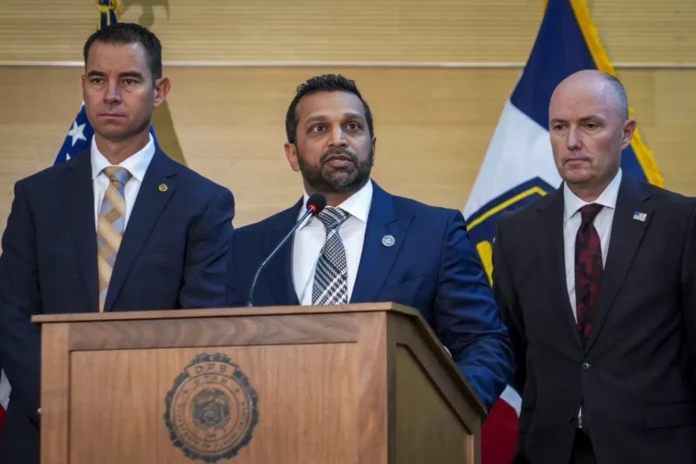
FBI Director Kash Patel has announced a major development in the investigation into the assassination of conservative activist Charlie Kirk, confirming that DNA evidence ties 22-year-old Tyler Robinson directly to the crime scene.
Speaking in a nationally televised interview on Monday, Patel said investigators matched Robinson’s DNA to two critical pieces of evidence: a screwdriver found on the rooftop where the fatal shot was fired, and a towel wrapped around the rifle later discovered in nearby woods.
“The DNA hits from the towel and the screwdriver are positively processed for the suspect in custody,”
Patel said. He added that the firearm itself remains under forensic review at Bureau of Alcohol, Tobacco, Firearms and Explosives (ATF) laboratories in Maryland.
A tweet from X.
The 31-year-old founder of conservative activist group Turning Point USA, Kirk, was murdered after being shot while giving a speech at a weekend event at Orem’s Utah Valley University on September 10, 2025. About 3,000 people attended when one rifle shot struck Kirk, and campus was in widespread panic.
Officers immediately recognized Robinson as a suspect, and they initiated a days-long, cross-state hunt that concluded with his arrest.
Evidence Linking Robinson
Screwdriver: Found on the rooftop believed to be the sniper’s perch; matched Robinson’s DNA.
Towel: Wrapped around the rifle, discovered in wooded terrain near the university; also carried Robinson’s DNA.
Firearm: Still under analysis at ATF labs in Maryland, where ballistics and trace evidence are being processed.
Patel personally visited the crime scene, describing how FBI evidence teams cycled in “air assets, evidence response technicians, and special operators” to secure and transport materials quickly.
Robinson was taken into custody after a family member recognized him from suspect images released by police. Officials say he has refused to cooperate since his arrest.
Prosecutors are preparing capital charges, citing evidence of premeditation, including a partially reconstructed note recovered from digital devices. Investigators are also reviewing Robinson’s online activity for possible motive.
Patel’s leadership of the FBI has already faced scrutiny in Congress, particularly after a wave of senior personnel changes earlier this year. Some lawmakers accused him of politicizing the bureau.
The assassination has further inflamed partisan divides, with conservative leaders calling Kirk’s killing a political act of terror, while critics of Patel point to missteps in the bureau’s early communications during the manhunt.
“False narratives spread six times more quickly than accurate ones,”
media commentators caution, citing how such instances take a toll on people’s ability to discern fact versus fiction.
Utah Governor Spencer Cox called Kirk’s assassination “a devastating act of political violence” and praised the rapid work of law enforcement. Turning Point USA issued a statement mourning their founder, describing him as “a fearless advocate for young conservatives whose legacy will outlast this tragedy.”
The next phase of the investigation will hinge on ATF’s firearm analysis and the filing of formal charging documents. Patel also faces scheduled congressional hearings, where he is expected to answer questions about both the case and his management of the FBI.
The assassination of Kirk is among the most prominent political violence moments in recent U.S. history. For the general American population, it immediately raises concerns about security in public events, ideological extremity, and whether there can be confidence in institutions to seek justice in a polarizing atmosphere.
The case also highlights fact-checking in modern journalism. In the days of immediate spreading of unverified claims, confirmation by reputable media and forensic evidence remains supreme.
“It is a sad time,”
said Patel,
“but it is our job to bring out clarity and justice. And it begins with facts.”