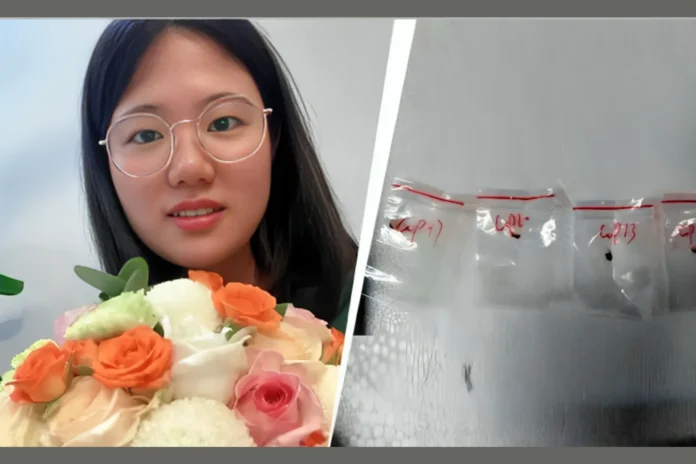
Federal authorities accused two Chinese nationals of smuggling a hazardous fungus into the country, sparking concern about biosecurity and Chinese interference in U.S. research facilities. The pathogen, Fusarium graminearum, has a reputation for decimating crops and presenting health hazards for both humans and animals.
U.S. Customs and Border Protection agents at Detroit Metropolitan Airport arrested Zunyong Liu, 34 and a Chinese agricultural researcher, on July 27, 2024, for carrying suspicious plant material in his luggage. It turned out to be Fusarium graminearum, a fungus that is a potential tool for agroterrorism. Liu denied any knowledge at first, but eventually confessed to smuggling it for research at the University of Michigan, where his girlfriend, Yunqing Jian, age 33, is a postdoctoral fellow.
Following a year-long FBI investigation, Jian was arrested on June 3, 2025. The couple faces charges of conspiracy, smuggling goods, visa fraud, and making false statements. Court documents reveal communications between Jian and Liu planning the smuggling, with evidence suggesting Jian’s loyalty to the Chinese Communist Party (CCP) and funding from the Chinese government for similar research .
Fusarium graminearum, known as Gibberella zeae, is responsible for Fusarium head blight, a disease that affects civilians including wheat, barley, maize and rice. Annually, the fungus is responsible for billions of dollars in global economic losses through decreased crop yields and grain contamination with mycotoxins like deoxynivalenol. The toxins are known to cause vomiting, liver damage and reproductive problems in humans and livestock. Its use as an agroterrorism weapon would be derived from the promise that it holds to decimate food supplies giving it weight in national security.
The charges against Jian and Liu highlight broader concerns about foreign espionage in U.S. research institutions. FBI Director Kash Patel stated,
“This is a chilling reminder that the Chinese Communist Party is still sending operatives and researchers into our institutions and into our food supply, an action that will hamstring our economy and put American lives in danger.”
U.S. Attorney Jerome Gorgon added,
“The alleged actions of these Chinese nationals—including a loyal member of the Chinese Communist Party—are of the gravest national security concerns. These two aliens have been charged with smuggling a fungus that has been described as a potential agroterrorism weapon into the heartland of America” .
Jian remains in custody awaiting a bond hearing, while Liu is believed to be in China, where the lack of an extradition treaty makes his arrest unlikely unless he returns to the U.S.
The University of Michigan, where Jian effort research, separated itself from the incidentanya at the University of Michigan, where Jian does research, distanced itself from the incident. In a statement, the university said,
“We denounce any activities that would seek to do harm or threaten any individual or threaten national security. We’re committed to knowledge, and to playing within whatever law and regulation is in place.We received no funding from the Chinese government in relation to research conducted by the accused individuals and will continue to cooperate with federal law enforcement”.
The university lacked federal permits to handle such high-risk pathogens, underscoring oversight gaps.
The case comes amid increased scrutiny by the United States of Chinese researchers amid geopolitical tensions. The Trump administration has promised to cancel visas issued to Chinese citizens working in sensitive areas, preserving that concern of intellectual property theft and spying. The incident comes amid a string of other cases of Chinese nationals at American universities, including the 2024 charges brought against five students at the University of Michigan for allegedly attempting to “obfuscate” a trip shot to death a military site.