

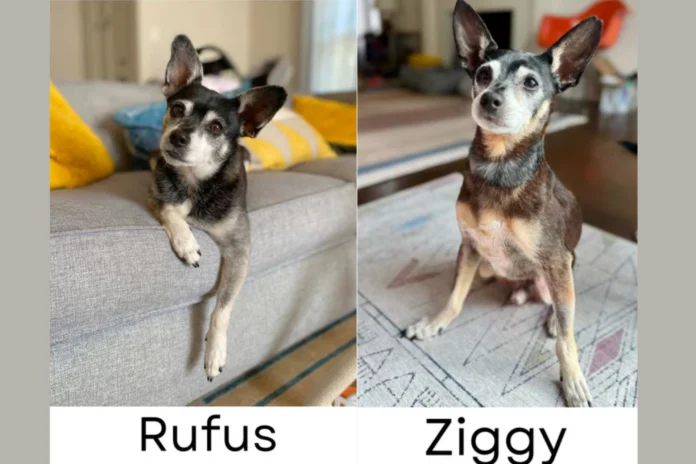
“It felt like the most profound loss you can imagine,” Jillian Reiff says. What happened next felt like fate — and was confirmed by science.
When Rufus, the beloved family dog of nearly a decade, passed away unexpectedly this past April, Jillian Reiff and her family were heartbroken.
“He was there through everything — my engagement, wedding, childbirth, moving into our home,” Jillian tells . “He was part of every milestone. Losing him was gut-wrenching.”

Rufus, a spunky half-Chihuahua, half-rat terrier, had been adopted from the San Francisco SPCA in 2016. Over the years, he became more than a pet — he was a family member, even learning to “say” the words “I love you.” So when he died at 15 from a sudden gallbladder issue, the family couldn’t imagine bringing another dog into their lives anytime soon.

But sometimes, the universe has a different plan.
That night, Jillian’s 9-year-old daughter Maya was scrolling online when she saw a photo on the Muttville Senior Dog Rescue website, which is based in San Francisco. The dog — a scruffy little fellow with soulful eyes — looked strikingly like Rufus.
“She turned the screen to me and said, ‘Mom, look. It looks like Rufus,’” Jillian recalls. “And he really did.”
They hadn’t planned to adopt. But a few days later, curiosity got the best of them, and the family drove to Muttville “just to meet him.” The dog’s mannerisms immediately struck them.
“The way he trotted, the way he tilted his head — it was Rufus,” she says. “My heart sank.”
They named him Ziggy — and brought him home just four days after Rufus’s passing.

That’s when the similarities became impossible to ignore.
“He laid down next to our kids in the exact same way. He was vocal, just like Rufus. And then, when he let out this specific warbling sound — the exact sound Rufus used to make when he was hungry — my husband and I just stared at each other,”
Jillian says.
Jillian performed a DNA test on Rufus in 2017 and has decided to do the same with Ziggy. The results left her speechless.
“It came back saying Ziggy was an identical match — Rufus’s biological father,” she says. “I was at work when I read the report. I screamed. I literally screamed in the middle of my office conference room. I couldn’t believe it.”
It turns out that both dogs had been in the care of the San Francisco SPCA around the same time — possibly even together — over 15 years ago. Ziggy, who had never found a forever home, was later taken in by Muttville, a nonprofit specializing in rescuing senior dogs.
Now, he was back with the family that unknowingly loved his son for nearly a decade.
“It feels like Rufus sent him to us,” Jillian says.
Behind this emotional reunion is cutting-edge science. Thanks to advances in canine DNA testing — with companies like Embark and Wisdom Panel — it’s now possible to trace breed lineage, health risks, and even familial relationships between dogs. The tests analyze thousands of genetic markers, and in cases like this one, can detect parent-offspring matches with near 100% accuracy.

Researchers have found that many behavioral traits in dogs — like attachment, vocalization, and playfulness — are strongly heritable. In Ziggy and Rufus’s case, those genetic echoes became the clues that brought them back together.
Canine DNA databases grow, and more pet owners discover surprising family ties between dogs adopted from different shelters or across various years. Some are even finding long-lost siblings or reuniting litters separated as puppies.
The experience has been nothing short of healing for Jillian and her family.
“We weren’t ready,” she says. “But somehow, he found us. And knowing that Ziggy is Rufus’s father — it brings this beautiful full-circle feeling to our grief.”
She hopes their story inspires others to consider adopting senior dogs — and to stay open to the unexpected.
“I believe there’s magic in this world,” she says. “And sometimes, science helps us see it.”
