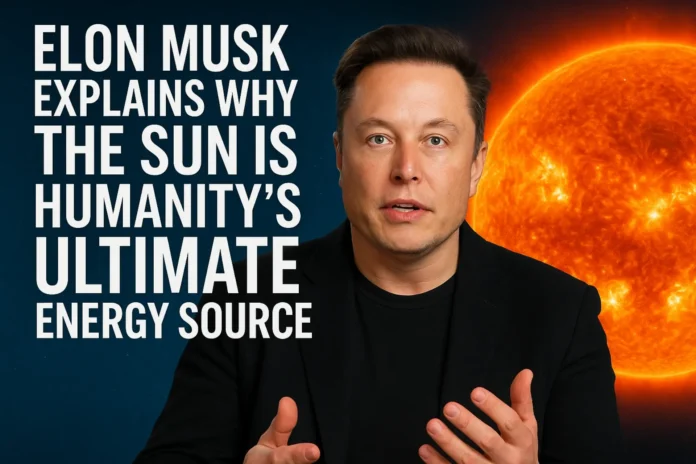
In a powerful video clip from his November 19, 2025, appearance at a high-profile U.S.-Saudi investment forum in Washington, D.C., Musk delivered a clear and passionate explanation of why the sun is the ultimate energy source for our future.
So, one of the ways you can think of the progress of any given civilization is on the Kardashev scale. And so, just a simple way of thinking about it is: You’re a Kardashev Level One if you’ve harnessed all the power of a planet. You’re two if you’ve harnessed all the power of a solar system. And you’re three if you’ve harnessed the power of a galaxy.
We’re very far from Three, it’s safe to say. But even from One. So when you think in Kardashev terms, it becomes undeniable that the sun is overwhelmingly the source of energy and everything else is tiny potatoes. Tiny potatoes are fine for now, but the sun is overwhelmingly the big potato. The humongous potato.
So it’s really harnessing the power of the sun that will lead us to the stars.”
/
Musk’s visionary power lies in his ability to connect today’s technology with a multi-planetary future of limitless solar abundance. He sees the sun not just powering homes, but fueling orbital AI data centers, electric fleets, and entire colonies on Mars, effectively ending energy scarcity and making humanity resilient against existential risks.
Elon Musk envisions a solar-powered future. He believes orbital solar farms, AI, and Starship's Mars expansion will rapidly advance humanity to a Type 1 civilization. #ElonMusk #SpaceX #SolarEnergy #Type1Civilization
— HypeFresh.com (@HypefreshC) November 24, 2025
🔗 Tap to see more – https://t.co/QHRH8qPFTT pic.twitter.com/WYdmDwrigP
Recent successes give weight to his words. On the same day he made this statement, xAI announced a 500-megawatt solar-powered data center in Saudi Arabia, with phases set to begin in 2026. SpaceX is on track for the first uncrewed Starship missions to Mars in late 2026. Tesla continues to drive a global solar boom, with installations rising 64 percent to 380 gigawatts in early 2025, while preparing to launch fully autonomous Cybercabs and Optimus humanoid robots next year.
From a journalistic perspective, Musk’s track record of turning impossible-sounding goals into reality, from reusable rockets to mass-market electric cars, forces us to take these timelines seriously. Yet the gap between today’s 1.4 terawatts of solar capacity and the roughly 10 quadrillion watts needed for Type 1 status remains enormous. Breakthroughs in energy storage, orbital manufacturing, and global cooperation will decide whether his roadmap stays on schedule.
In the end, one question towers above the rest: Will we actually get there? Musk has laid out the path and is building the tools at breathtaking speed, but reaching Kardashev Type 1 will demand more than vision; it will require humanity to match his ambition with collective action on a planetary scale.