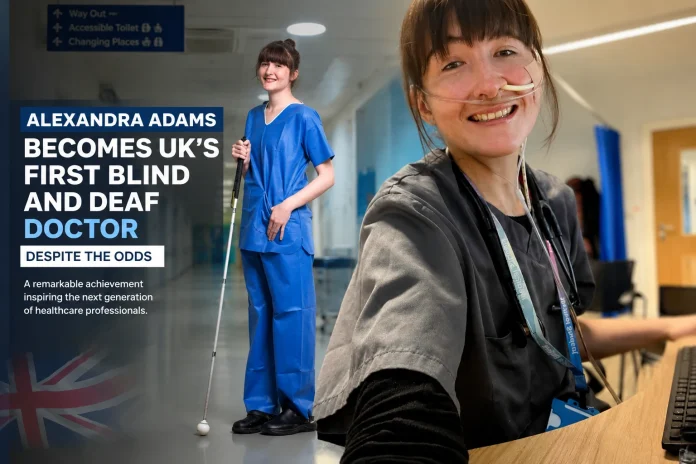
Meet 32-year-old Alexandra Adams. She’s blind, she’s deaf, and she’s about to walk into a hospital ward where patients are going to realise the doctor they just asked for… is sitting right there in front of them.
Born with congenital conditions that left her registered blind and deaf, Adams has less than 5% central vision in her left eye, none in the right, severe-to-profound sensorineural hearing loss, and a lifelong reliance on hearing aids. She’s been wearing them since she was two, uses a white cane for mobility, and can still pick out colour and shape – but night blindness means she’s effectively blind in the dark. Without her hearing aids, the world is silent.
Her medical journey hasn’t been a smooth one. Ehlers-Danlos Syndrome, Mast Cell Activation Syndrome, and respiratory muscle weakness have forced multiple intensive-care stays, sepsis episodes, and months of recovery. Yet here she is, a fully qualified doctor, graduating from Cardiff University Medical School in 2026 after more than a decade of training that included a brutal COVID-era break when she spent 17 months fighting pulmonary embolisms, aspiration pneumonia, and sepsis.
The story really started in a hospital bed. As a teenager training for the 2012 Paralympics (and later competing in para-snowsport), she went in for what was supposed to be a routine hernia repair. Instead she spent a year-plus in hospital after complications piled up. That’s when one doctor finally saw her. Not as a patient with a disability, but as a person. He asked if she was okay, showed her his own scar, and actually listened. That moment – and the patient-centred care she was starved of on the ward – lit a fire.
After she left hospital she restarted her education, self-taught her A-levels, then headed to a residential school for blind and partially-sighted students where she became head girl. Teachers warned her against university. One medical school offered her a place, promised support, then yanked it days before term started. She reapplied, started at Cardiff anyway, and spent the next ten years becoming a doctor.
On placements she met the other side of the coin: discrimination. A senior doctor on her very first clinical day asked whether any patient would actually want a disabled doctor and effectively sent her home. Patients, on the other hand, opened up to her instantly. Why? Because she’s lived the full patient experience. Her own surgeries, her own ICU stays, her own years of feeling invisible – that empathy is now her superpower.
Adams describes her deafblindness not as a limitation but as an upgrade. She listens harder, touches more, reads body language better than anyone relying on perfect vision and hearing ever could. So when she graduates in 2026 and starts her early shifts in a Dorset hospital this summer, the adaptations she uses are practical rather than flashy:
- A Bluetooth stethoscope that streams straight into her hearing aids
- Phone apps for magnification and text-to-speech
- An ophthalmoscope attachment that turns images into something her phone can display
- Simple, careful touch to find veins
She’s documented all of it on social media. She’s set her sights on palliative care, but first she’s out there speaking publicly, writing a memoir, and using every platform to prove a simple truth: disability exists on a spectrum, and the biggest barrier isn’t the impairment itself. It’s the low expectations of everyone else.
And here’s where UK law steps in. Under the Equality Act 2010, it’s illegal for any employer – including the NHS – to discriminate against a disabled person at work. That means mandatory reasonable adjustments: extra training for colleagues, flexible schedules, assistive technology, quiet spaces when needed. The NHS itself has published guidance on disability-inclusive workplaces, and the Employment Code of Practice spells out exactly what “reasonable” looks like. Adams isn’t asking for special treatment. She’s asking for the same basic respect every other doctor gets.
Patients are already noticing the difference. Colleagues are slowly catching up. And if the rest of the medical profession follows her lead, the UK might just see more doctors who look like the people they’re treating – not just the ones who fit the perfect-stereo-typical mould.
Alexandra Adams didn’t just become a doctor. She reminded us all what a doctor should be: human.