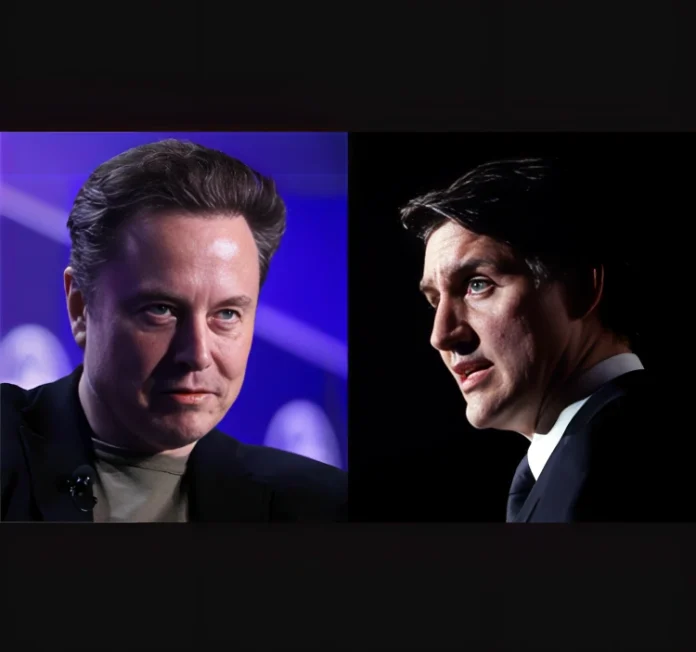
In one of the hottest online spats to come along in a while, tech billionaire Elon Musk, Canadian Prime Minister Justin Trudeau, and U.S. President-elect Donald Trump fired up a sea of hot smoke over just one litmus test: whether Canada was fit to be the 51st state of the U.S. The tempest erupted when Trump envisioned yet another audacious push for the integration of Canada, Trudeau rebuffed him with pointed words, and Musk joined in with a contentious remark that made the internet burn.
President-elect Donald Trump is facing sharp criticism for floating the notion that the U.S. could use “economic force” to bring Canada into the fold as its 51st state. Trump, who takes office later this month, doubled down on the idea, sharing a doctored map on social media showing Canada merged into the United States and writing, “Oh Canada!
Many people in Canada LOVE being the 51st State,” Trump asserted, adding that the U.S. could no longer afford “these massive trade deficits and subsidies” connected with its neighbor to the north. The plan has immediately outraged not just the politicians but also common people of Canada since such a movement is considered a serious affront to its self-sovereignty.
Former Canadian Prime Minister Justin Trudeau was quick and very firm in placing a lid on that Trump plan. From Ottawa, he minced no words: “There isn’t a snowball’s chance in hell that Canada would become part of the United States. Workers and communities in both our countries benefit from being each other’s biggest trading and security partner.”.
Trudeau’s comments emphasized the interdependence of the U.S.-Canada relationship, even as he pointed out the distinction between the two nations. But his tough speech was something with which many Canadians could identify, even if some critics suggested that his declining approval ratings and the recent resignation as Prime Minister may have blunted any impact.
Until finally, Elon Musk himself weighed in to the debate-again, via sharp comment at the conservative leader Trudeau with his usual unpredictable social media attacks. “Girl, you’re not the governor of Canada anymore, so it doesn’t matter what you say,” Musk wrote, apparently thinking that Canada is run by a “governor” rather than a Prime Minister.
The comment went viral, inspiring laughter and outrage. To some, Musk’s flippant tone was hilarious; to others, it was dismissive and uninformed. The billionaire’s comment underlined a developing feature of political discourse: the outsized role high-profile figures can play-particularly in the era of social media, where one tweet can drive news cycles.
Now, the loudest voices of the Canadians joined the chorus of defending independence against what came from the new president of their southern neighbors. Pierre Poilievre, a member of Parliament from Carleton, shot back fervently against the proposition raised by Trump: “Canada will never be the 51st state. Period. We are a great and independent country,” Poilievre said on X, formerly known as Twitter.
He added how big of a role Canada is for the U.S. in terms of one’s defense and trade, such as helping out with the post-9/11 retaliation against al-Qaeda and providing affordable, reliable energy. Poilievre vowed to put Canadian sovereignty first by promising to “put Canada First” if elected Prime Minister.
The Musk-Trudeau-Trump saga is a perfect epitome of how social media has come to be at the heart of political debates. Platforms like X amplify voices, escalate controversies, and further blur the line between serious political discourse and entertainment. Musk’s comments have no doubt driven massive engagement but also raise questions of accountability and the impact influential figures have on public opinion.