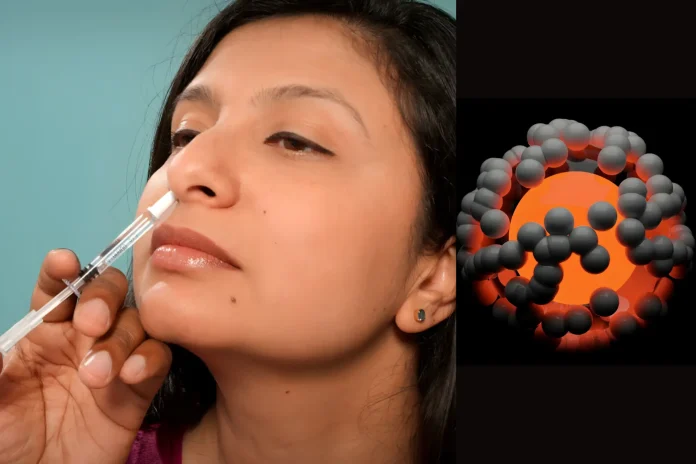
Could the next leap in connecting brains to computers skip the surgeon’s knife and start with a nasal spray? That is the pitch fueling viral headlines about a Palo Alto startup and its experimental approach, now amplified by the arrival of one of AI’s most famous futurists.
Subsense, a Silicon Valley neurotechnology company, is developing what it calls NanoBCI a non-surgical brain-computer interface that uses engineered nanoparticles delivered through the nose, paired with an external wearable headset. The particles are intended to travel via the olfactory pathway into the brain, where they would act as temporary interfaces with neurons. An external device, described in early mock-ups as resembling a hybrid baseball-cap-and-bike-helmet, would then interact with them wirelessly.
The company describes two main nanoparticle types. Plasmonic nanoparticles are proposed to help read neural activity by scattering near-infrared light differently in response to local electrical fields from neurons. Magnetoelectric nanoparticles would convert external magnetic fields from the headset into localized electrical effects capable of stimulating nearby neurons. The full bidirectional system has not been demonstrated in humans.
Subsense has raised approximately $27 million, first emerging from stealth with about $17 million and later adding $10 million from Golden Falcon Capital. It has conducted preclinical research that includes mouse experiments focused on nanoparticle delivery, brain entry, stimulation, and related effects. Near-term interest centers on medical applications for neurological conditions such as Parkinson’s disease and epilepsy. Longer-term company goals include clinical pilots in the late 2020s and possible broader uses after that targets, not guarantees. The company has begun early FDA engagement but has no approved product.
The latest surge of attention came in early September 2026 when Ray Kurzweil, the AI pioneer, inventor, and longtime advocate of human-machine integration, joined Subsense as a product and vision advisor.
“For years, I have believed that the convergence of AI, nanotechnology and neuroscience could fundamentally change how humans interact with technology,”
Kurzweil said.
“Subsense is pursuing an approach that brings those fields together in a particularly compelling way.”
At a company event he added,
“Ultimately, we want to merge the smartphone with the brain.”
CEO Tetiana Aleksandrova described the potential this way:
“I believe the brain-computer interface eventually may become one of the most intimate technologies that human beings ever created.”
Kurzweil’s involvement brings high-profile interest and aligns with his decades of writing on the singularity and expanding human capability. It does not constitute scientific proof that NanoBCI works. Delivery efficiency, precise targeting, signal quality, reliable stimulation, long-term nanoparticle behavior, and human safety remain open questions. Independent reporting consistently notes the technology is still preclinical and years from possible clinical or consumer use.
Viral framing that reduces the story to “snorting nanoparticles to connect your brain to a computer” captures attention but flattens important distinctions. Intranasal delivery is the company’s proposed method, often compared to a nasal spray rather than recreational “snorting.” No one is currently using a working consumer BCI of this type. Subsense is real, the $27 million is real, the mouse-stage research is real, and the non-surgical ambition is serious. The sci-fi version of seamless brain-computer links remains far ahead of the science that has been shown so far.