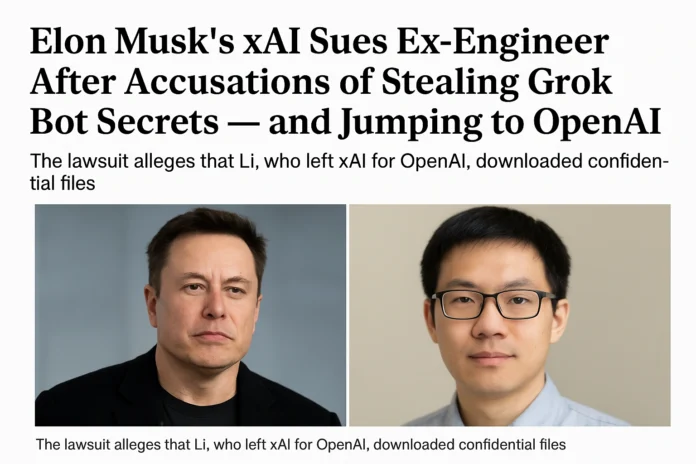
Elon Musk’s artificial intelligence startup, xAI, has filed a lawsuit against former engineer Xuechen Li, accusing him of stealing confidential information about the company’s Grok chatbot before joining rival OpenAI.
The lawsuit, filed on August 28 in California federal court, alleges that Li not only downloaded sensitive files but also uploaded xAI’s entire codebase to personal devices in preparation for his transition to OpenAI.
According to court filings, Li—one of xAI’s earliest engineers, hired in 2024—admitted during an August 14 confrontation that he had taken company data while “covering his tracks.” The complaint accuses Li of “willfully and maliciously” copying confidential material from his xAI-issued laptop onto personal systems after securing a position at OpenAI.
Li, a Stanford PhD in Computer Science who completed his doctorate in three years, was instrumental in training and developing Grok, xAI’s flagship chatbot. The lawsuit describes the stolen data as “cutting-edge AI technologies with features superior to those offered by ChatGPT.”
Li’s financial activity has also drawn scrutiny. Court documents reveal he sold roughly $7 million in xAI stock in the weeks following his resignation. This included $4.7 million in June 2025 and an additional $2 million worth of shares in July—a sale facilitated by xAI, which sought to retain him due to his “critical contributions.”
Just three days after completing those transactions, on July 28, Li resigned from the company. He was scheduled to begin work at OpenAI on August 19.
Investigators claim Li took steps to cover his tracks, including deleting browser histories, clearing system logs, and renaming files before uploading them to external devices. During the August 14 confrontation, Li allegedly provided a handwritten confession, though subsequent forensic analysis uncovered more stolen materials that he had not disclosed.
The lawsuit comes amid fierce competition in Silicon Valley’s AI sector. xAI contends that Li’s theft could save OpenAI “billions of dollars and years of development,” accelerating improvements to ChatGPT by incorporating Grok’s more advanced features.
The dispute also deepens the rift between Musk and OpenAI, the company he co-founded in 2015 but left in 2018. Musk has since been a vocal critic, recently filing a separate antitrust lawsuit against OpenAI and Apple over alleged monopolization of AI chatbot access on Apple devices.
OpenAI, while not named as a defendant in the Li case, has dismissed Musk’s legal actions as part of an “ongoing pattern of harassment.”
xAI is seeking monetary damages and injunctive relief, including a restraining order to block Li from starting work at OpenAI. The company argues that allowing Li to proceed would give its rival an unfair competitive advantage.
With the industry’s rapid growth and escalating legal battles, the outcome of this case may influence how future disputes over proprietary algorithms, training methods, and AI talent transitions are resolved.