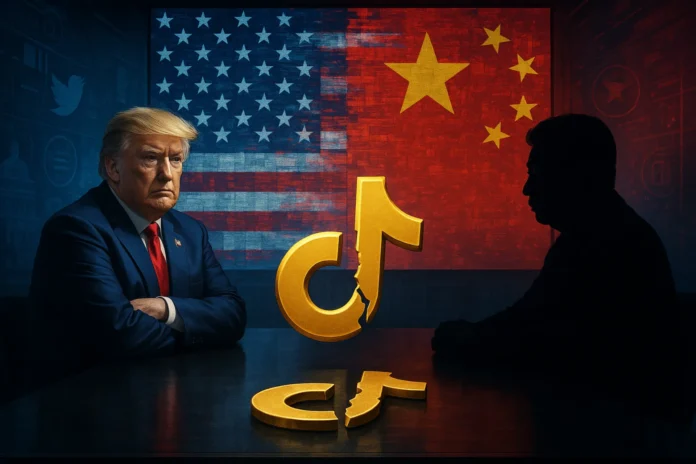
With the clock ticking on one of the world’s most popular apps, TikTok’s 170 million U.S. users were jolted on Sunday by President Donald Trump’s cryptic claim: a buyer for TikTok has been found and their identity will be revealed
“in about two weeks.”
Speaking on Fox News’ Sunday Morning Futures, Trump stated,
“We have a buyer for TikTok, by the way. I think I’ll need probably China approval … I’ll tell you in about two weeks. It’s a group of very wealthy people.”
The interview, recorded June 29 and aired June 30, comes just 10 days after Trump granted a third extension on TikTok’s U.S. sell-or-ban deadline.
Under the Protecting Americans from Foreign Adversary Controlled Applications Act, passed in 2024, ByteDance the Chinese owner of TikTok must divest its U.S. operations by January 19, 2025, or the app faces a nationwide ban. Trump, now again at the helm, has issued three deadline extensions: January 20, April 4, and June 19 pushing the final sale deadline to September 17, 2025.
TikTok isn’t just a dance app anymore. With 170 million U.S. users and 7.5 million businesses relying on it, the platform is central to American digital culture and commerce. Its estimated $50 billion valuation further underscores the scale of this unprecedented tech standoff.
Trump’s announcement has fueled speculation and confusion alike. While his statement confirms a buyer has been identified, he offered no names only that it’s “a group of very wealthy people.” He added that approval from Chinese President Xi Jinping will likely be needed for the deal to proceed.
This wouldn’t be the first time a TikTok sale made headlines. Previous bids, including high-profile attempts by Oracle, Blackstone, and Andreessen Horowitz, collapsed amid concerns from Beijing mainly over access to TikTok’s algorithm and mounting trade tensions.
Critics argue Trump’s repeated use of executive orders to extend the TikTok deadline sidesteps Congress. Others warn that the deal’s fate hinges on volatile U.S.-China relations, especially after Trump’s re-imposition of tariffs earlier this year. In 2024, TikTok was at the center of heated debates over national security, with fears the app could funnel data to the Chinese government claims ByteDance has consistently denied.
“Without transparency, it’s hard to tell whether this is a legitimate business transaction or political theater,”
said Dr. Karen Liu, a tech policy analyst at the Brookings Institution.
TikTok isn’t just about lip-syncs and filters it’s where small business owners advertise, young voters get political news, and creators build careers.
“TikTok brings 60% of our website traffic,”
said Lisa Matthews, who runs a vintage clothing store in Chicago.
“A ban would seriously hurt my business.”
During the 2024 election, TikTok played a major role in energizing Trump’s youth vote, a point he’s acknowledged.
With the September 17 deadline looming, the coming weeks are critical. Will the unnamed buyer step forward? Will Beijing approve the deal? Or is this yet another political bluff in the long-running TikTok saga?