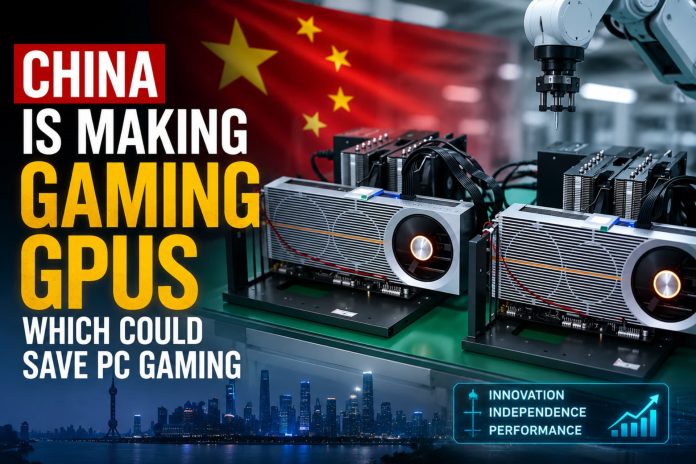
China’s New Gaming GPU Tests Self Reliance Limits in a Constrained Semiconductor Landscape.
China has launched its first serious domestic gaming graphics card with the potential to introduce real competition into a market long dominated by a handful of players. Lisuan Tech, a Shanghai-based GPU startup founded in 2021 by former S3 Graphics engineers, unveiled the LX 7G100 Extreme Founders Edition as a 12 gigabyte GDDR6 card built on a 6 nanometer process.
The hardware earned Microsoft WHQL certification, the industry standard that validates driver stability and Windows compatibility. This makes Lisuan only the fourth company to achieve such certification, joining NVIDIA, AMD, and Intel. Early tests show the card delivers performance similar to the older RTX 3060 while supporting over 100 modern titles through standard APIs.
Yet driver maturity remains a critical variable that could determine whether this card gains meaningful traction beyond initial domestic interest.
This development arrives at a time when PC gamers continue to face high prices and limited choices from established suppliers. Lisuan designed the card in house with its TrueGPU architecture to advance national goals for semiconductor independence.
The company began as a 2021 startup founded by veterans from S3 Graphics. Memory specialist Dosilicon has provided substantial backing, holding a significant stake and contributing hundreds of millions in funding rounds.
Production remains limited for now with only 1000 units in the initial Founders Edition batch priced between $436 and $485. Reviewers note solid out-of-box compatibility thanks to the WHQL milestone.
Chinese reviewers have confirmed the card runs recent games such as Cyberpunk 2077 at respectable 1080p frame rates with surprisingly few crashes.
The LX 7G100 offers several notable display and power specifications:
- 225 watt power draw through a single eight pin connector
- Four DisplayPort outputs capable of 8K60 HDR
- FreeSync compatibility for smoother frame delivery
Real world gaming results still fall short of current midrange options from NVIDIA and AMD. Stuttering and inconsistent frame pacing appear in several titles. The driver control panel offers almost no usable settings and overclocking modes reset after reboots.
The card lacks hardware ray tracing support at launch. These limitations highlight how driver maturity directly impacts adoption. While the WHQL certification provides a strong foundation for stability and Windows compatibility, ongoing software optimization will decide if the card evolves into a viable alternative or remains a proof of concept.
Past Chinese GPU efforts required months of patches before achieving playable performance in modern libraries. Lisuan appears further along but still needs substantial updates to address frame timing and feature parity.
The broader Chinese semiconductor supply chain context adds depth to this launch. Years of United States export restrictions on advanced tools and chips have accelerated domestic efforts across design, fabrication, and memory production.
Lisuan relies on local 6 nanometer capacity likely tied to SMIC, China’s largest domestic semiconductor foundry, and allied foundries as part of Beijing’s push for self sufficiency outlined in the latest Five-Year Plan. Dosilicon supplies memory components while government linked funds support the ecosystem.
This integrated approach aims to reduce vulnerability to external controls but faces persistent gaps in advanced manufacturing equipment and high end processes compared to leaders in Taiwan. The strategy prioritizes complete domestic loops for AI and consumer hardware.
Success with the LX 7G100 could validate this model even if raw performance trails competitors. It demonstrates functional alternatives emerging under pressure. Yet supply chain localization also raises questions about long term scalability and global export potential given ongoing technology controls.
Driver maturity will shape the card’s influence on PC gaming. Strong initial compatibility reduces barriers that doomed earlier domestic attempts. Continued updates could close gaps in features and efficiency over time similar to how other new entrants improved post launch.
For now the card offers a starting point that proves Chinese engineering can deliver playable results in a wide title range. Gamers evaluating early adoption should watch software patches closely. Lisuan has outlined plans for additional models with better performance in coming generations.
The official product page details full specifications for those tracking progress. This launch represents a notable step in diversifying graphics hardware options. Its ultimate impact depends on how quickly the software ecosystem matures alongside supply chain advancements.